Rural Water Conservancy Renovation: Customized Geotextiles Adapted to Small Watershed Management
Product Definition
Customized geotextiles for rural water conservancy renovation are engineered permeable fabrics designed to meet site-specific hydraulic, soil, and load conditions in small watershed management, providing filtration, separation, reinforcement, and erosion control for sustainable rural infrastructure systems.
Technical Parameters and Specifications
In small watershed management, geotextile performance must align with hydrological variability, soil characteristics, and long-term durability requirements.
Material type: Polypropylene (PP) or Polyester (PET)
Mass per unit area: 100–600 g/m²
Tensile strength: 8–40 kN/m (MD/CD)
Elongation at break: 15%–80%
CBR puncture strength: ≥1.2–6.5 kN
Apparent opening size (AOS): 0.07–0.30 mm
Water permeability (normal to plane): ≥10⁻³ m/s
UV resistance: ≥70% strength retention after 500 hours
Service life (buried conditions): ≥25 years
Structure and Material Composition
Customized geotextiles are designed by adjusting fiber type, bonding method, and structural density to adapt to diverse rural water conservancy conditions.
Fiber Layer: High-tenacity PP or PET staple or filament fibers
Bonding Structure: Needle-punched, heat-bonded, or composite bonding
Pore Structure: Controlled pore size distribution for soil retention
Surface Treatment: Anti-UV or anti-aging additives (optional)
Edge Configuration: Customized roll width and edge reinforcement
Manufacturing Process and Engineering Controls
Engineering-Oriented Manufacturing Steps
Raw polymer selection and melt processing
Fiber spinning and drawing
Web formation through carding or air-laying
Needle punching or thermal bonding
Heat setting and dimensional stabilization
Precision cutting, rolling, and packaging
Key Equipment and Process Control Points
Critical equipment includes fiber extruders, carding machines, needle looms, and online thickness gauges. Process controls focus on fiber orientation uniformity, needle density, mass tolerance (±5%), and permeability consistency to ensure predictable hydraulic performance in field applications.
Industry Comparison: Geotextiles vs. Traditional Materials
| Material | Filtration Performance | Durability | Installation Efficiency | Typical Use in Watersheds |
|---|---|---|---|---|
| Customized Geotextiles | High, controlled | High | High | Channel lining, embankments |
| Gravel Filter Layers | Medium | High | Low | Traditional drainage |
| Clay Liners | Low permeability | Medium | Low | Seepage control |
| Concrete Structures | None | Very High | Low | Rigid channels |
Application Scenarios in Small Watershed Management
Customized geotextiles are widely applied in rural water conservancy renovation projects involving:
Riverbank and channel slope stabilization
Small irrigation canal lining systems
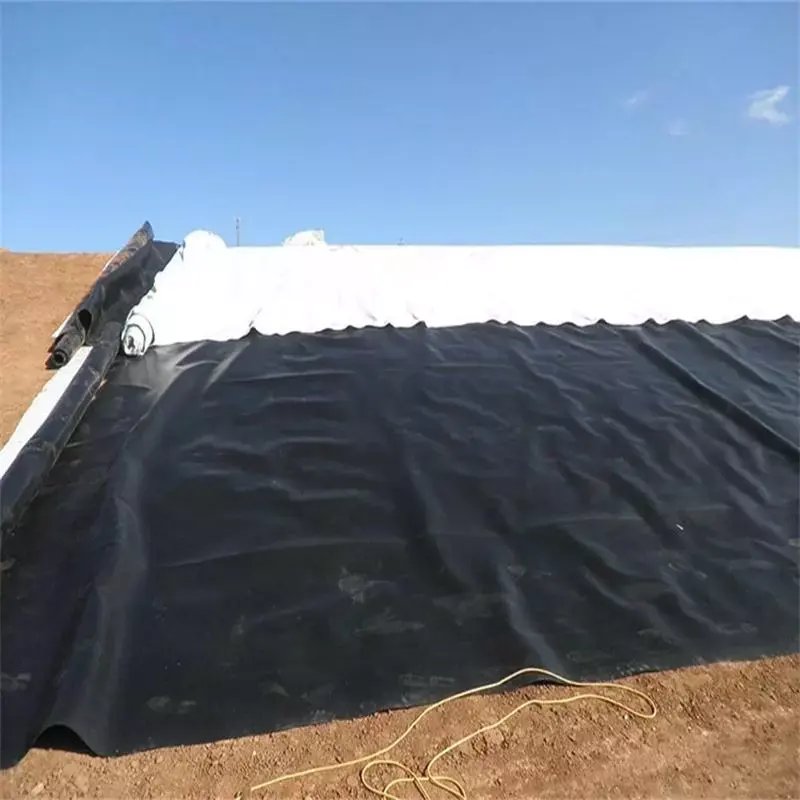
Reservoir and pond seepage control layers
Flood discharge channels and spillways
Rural road drainage and culvert protection
Primary stakeholders include EPC contractors, local infrastructure developers, water conservancy bureaus, engineering consultants, and material distributors.
Core Pain Points and Engineering Solutions
Pain Point 1: Soil Erosion During Seasonal Flooding
Solution: Specify geotextiles with matched AOS and permeability to local soil gradation.
Pain Point 2: Limited Construction Access in Rural Areas
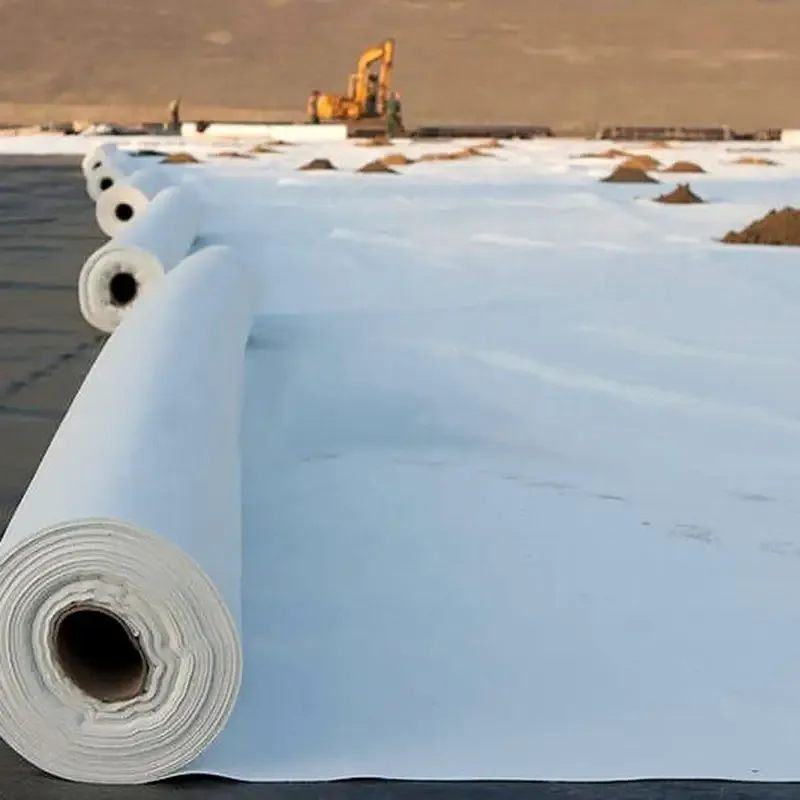
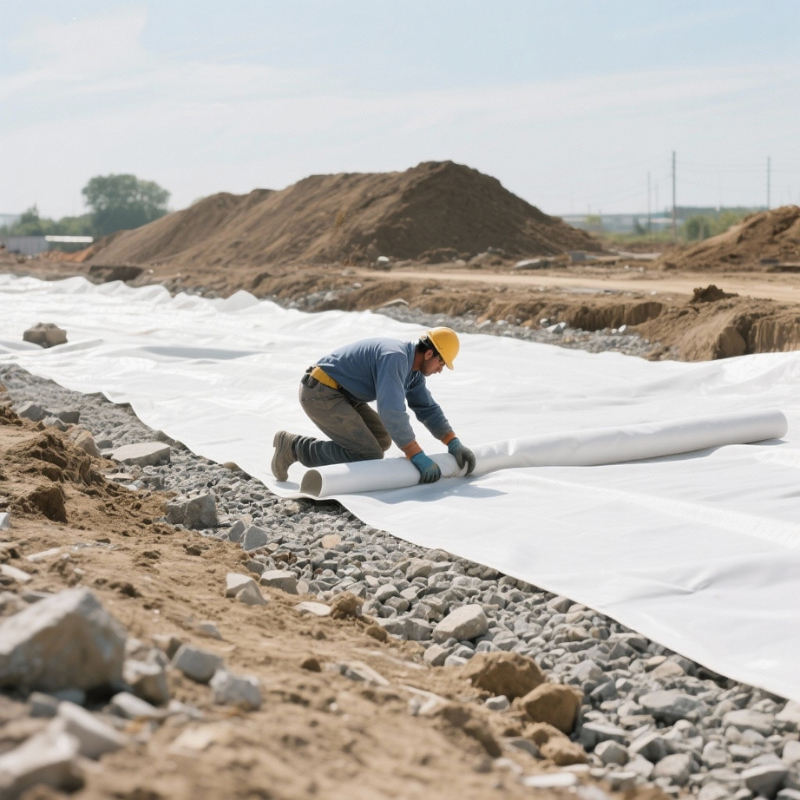
Solution: Use lightweight roll-based geotextiles to reduce equipment and labor demands.
Pain Point 3: Long-Term Sediment Clogging
Solution: Design layered systems combining geotextiles with graded aggregates.
Pain Point 4: Budget Constraints in Rural Projects
Solution: Apply customized specifications instead of over-designed standard products.
Risk Warnings and Mitigation Measures
Risk: Improper pore size selection causing piping
Mitigation: Conduct soil analysis before specificationRisk: UV degradation in exposed areas
Mitigation: Use UV-stabilized or covered installationRisk: Installation damage from sharp aggregates
Mitigation: Specify minimum CBR puncture strengthRisk: Hydraulic uplift during peak flows
Mitigation: Combine with anchoring or ballast systems
Procurement and Selection Guide
Assess watershed hydrology and design flood levels
Analyze soil type and particle size distribution
Define functional requirements (filtration, reinforcement, separation)
Select material type and mass per unit area
Verify compliance with local water conservancy standards
Review laboratory test reports and quality certifications
Request project-specific samples or trial sections
Engineering Case Study
In a rural watershed renovation project covering 6.5 km of irrigation channels, a 300 g/m² needle-punched PP geotextile was installed beneath riprap linings. The system reduced soil loss during monsoon seasons and maintained stable channel geometry after three years of operation, with no recorded clogging or structural failure.
Frequently Asked Questions (FAQ)
Q1: Why use customized geotextiles instead of standard grades?
Customization ensures compatibility with local soil and hydraulic conditions.
Q2: Are geotextiles suitable for small-scale rural projects?
Yes, they are especially effective in decentralized watershed systems.
Q3: How is service life estimated?
Based on material type, burial conditions, and environmental exposure.
Q4: Can geotextiles replace gravel filters?
In many cases, yes, or they can be combined.
Q5: What standards are commonly referenced?
ISO, EN, and local water conservancy technical codes.
Q6: Is skilled labor required for installation?
Basic training is sufficient for most applications.
Q7: How are seams handled on-site?
By overlap, sewing, or thermal bonding depending on design.
Q8: Can geotextiles be used in cold regions?
Yes, PP and PET perform well under sub-zero conditions.
Q9: Do geotextiles affect water quality?
No, they are chemically inert in typical applications.
Q10: Is third-party testing necessary?
Recommended for government-funded or critical projects.
Call to Action
For customized specifications, technical datasheets, engineering samples, or support in rural water conservancy renovation projects, procurement and engineering teams should request detailed technical consultation from qualified geosynthetic suppliers.
E-E-A-T: Author Expertise and Industry Authority
This article is authored by a geotechnical engineering specialist with extensive experience in water conservancy infrastructure, small watershed management, and geosynthetics application, providing technically sound guidance for professional B2B decision-makers.