Geogrid Material and the Principle of Adaptation to Engineering Scenarios
Product Definition
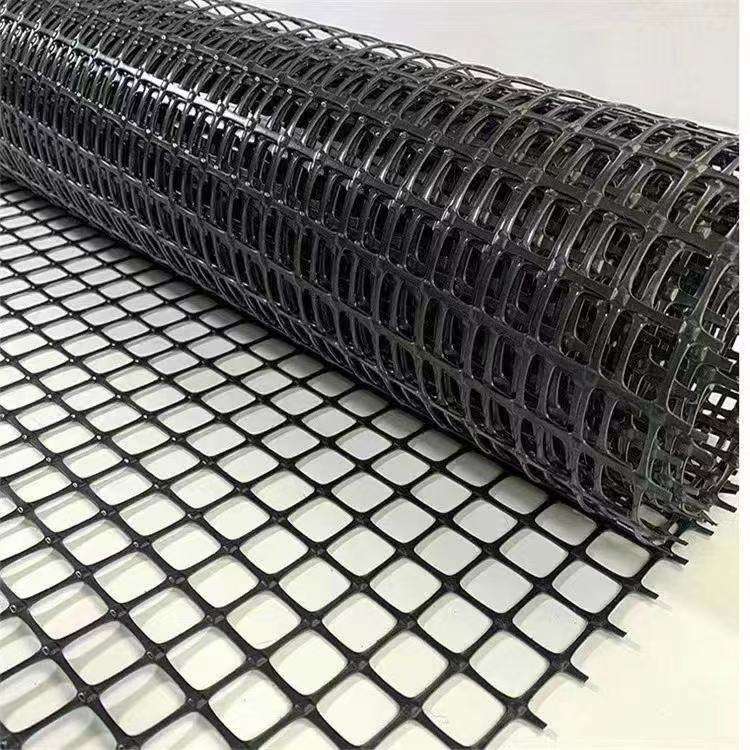
Geogrid material is a polymer-based geosynthetic engineered to reinforce soil and aggregate systems. By providing tensile strength and interlocking capacity, geogrids improve load distribution, enhance structural stability, and extend service life in transportation, slope stabilization, and foundation engineering applications.
Technical Parameters and Specifications
Geogrid performance is defined by mechanical, physical, and durability parameters that must align with project requirements.
Tensile strength: 20–200 kN/m (machine and cross-machine directions)
Elongation at break: ≤10% for rigid grids, ≤15% for flexible grids
Aperture size: 25 × 25 mm to 65 × 65 mm, depending on aggregate gradation
Polymer type: PP, HDPE, PET, or fiberglass
Creep reduction factor: ≥1.3 (design-dependent)
Design service life: 50–120 years under normal soil conditions
Structure and Material Composition
Geogrids consist of an integrated grid structure designed to mobilize soil confinement and tensile reinforcement.
Load-bearing ribs: Oriented polymer ribs providing tensile resistance
Nodes or junctions: Welded or integrally formed intersections ensuring force transfer
Apertures: Openings that enable soil–aggregate interlock
Surface treatment: Coatings or stabilization additives for UV and chemical resistance
Manufacturing Process
Geogrid production follows controlled industrial processes to ensure consistency and structural reliability.
Polymer selection and compounding with stabilizers
Sheet extrusion or yarn formation using precision extruders
Punching or weaving to form grid apertures
Molecular orientation through stretching to increase tensile strength
Welding or integral node formation
Quality control testing (tensile, creep, junction strength)
Industry Comparison
| Material | Tensile Reinforcement | Soil Interaction | Typical Applications |
|---|---|---|---|
| Geogrid | High | Excellent interlock | Roads, slopes, retaining walls |
| Geotextile | Moderate | Separation and filtration | Drainage, erosion control |
| Steel reinforcement | Very high | Limited soil interaction | Concrete structures |
Application Scenarios
Geogrid material is widely adopted by EPC contractors, infrastructure developers, and engineering consultants.
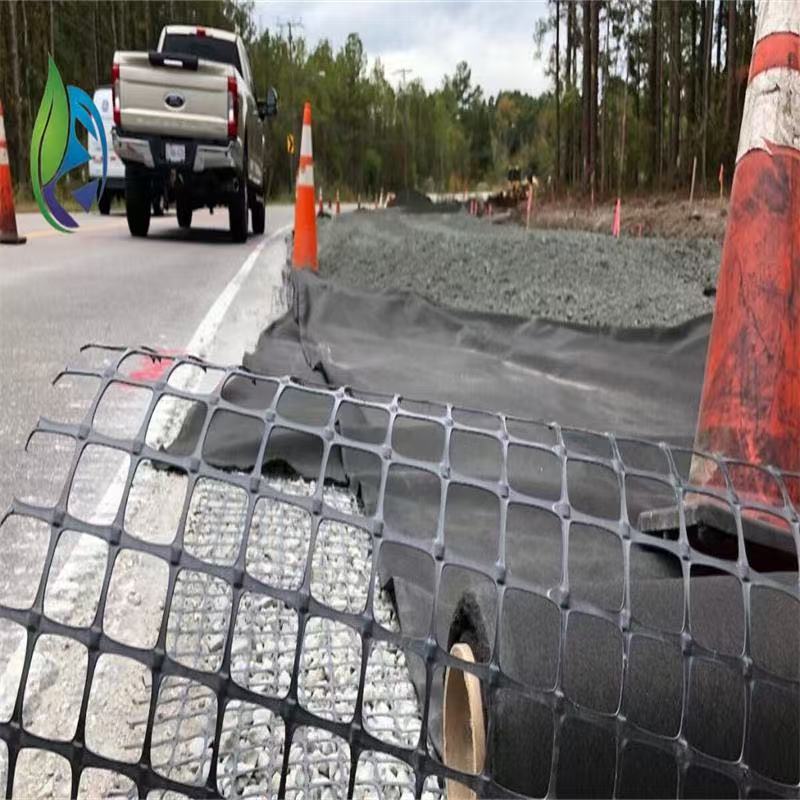
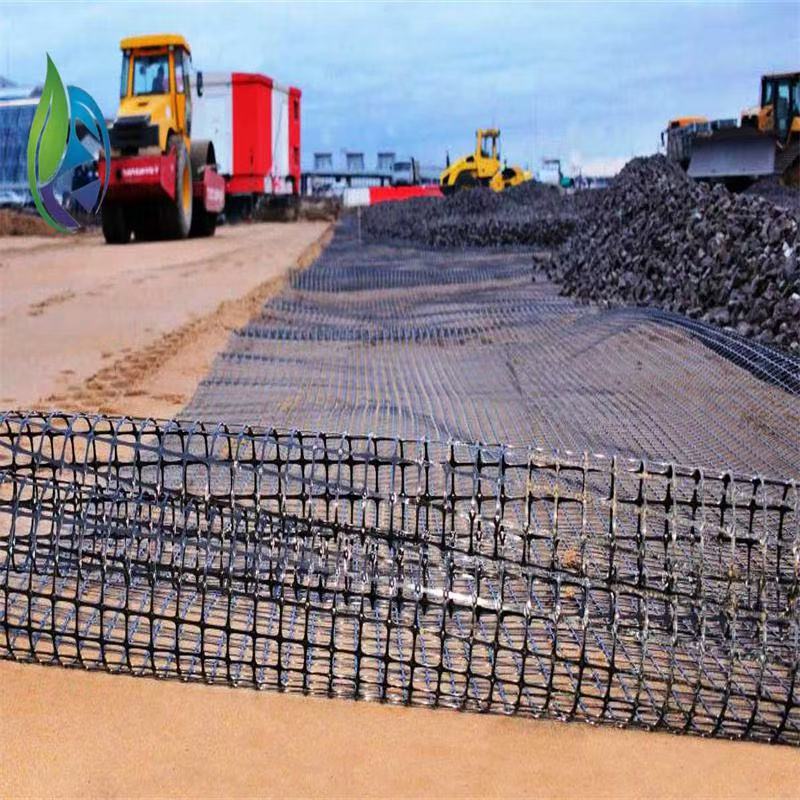
Road and railway base reinforcement
Embankment and slope stabilization
Mechanically stabilized earth (MSE) walls
Port, airport, and industrial yard foundations
Core Engineering Pain Points and Solutions
Uneven settlement: Geogrids distribute loads and reduce differential deformation
Weak subgrade soils: Tensile reinforcement improves bearing capacity
Slope instability: Grid–soil interaction enhances shear resistance
High maintenance costs: Extended pavement life lowers lifecycle expenses
Risk Warnings and Mitigation Measures
Incorrect geogrid selection or installation can compromise performance.
Risk of inadequate tensile strength — verify design loads
Improper aperture size — match grid to aggregate gradation
UV exposure during storage — use protective coverings
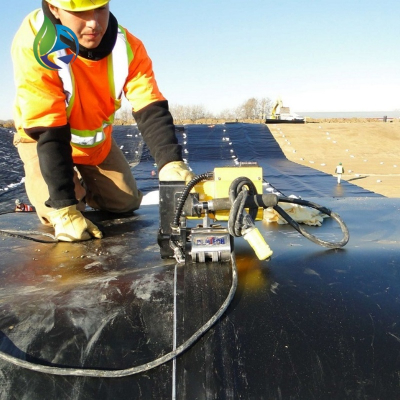
Insufficient overlap — follow engineering specifications
Procurement and Selection Guide
Define project load and service life requirements
Assess soil type and bearing capacity
Select appropriate polymer and tensile class
Match aperture size to fill material
Review third-party test reports
Confirm installation guidelines and technical support
Engineering Case Application
In a highway widening project on soft clay subgrade, uniaxial PET geogrids (100 kN/m) were installed beneath the base layer. Plate load tests showed a bearing capacity increase of over 40%, while post-construction monitoring confirmed reduced rutting and stable performance after five years of operation.
FAQ
What is the primary function of geogrid material? Soil and aggregate reinforcement.
Can geogrids replace traditional reinforcement? In many soil applications, yes.
How long does geogrid last? Typically 50–120 years depending on conditions.
Is geogrid suitable for soft soils? Yes, with proper design.
What polymers are commonly used? PP, HDPE, PET, fiberglass.
Does aperture size matter? Yes, it affects soil interlock.
Are geogrids resistant to chemicals? Most are stable in common soil environments.
Can geogrids be used in slopes? Yes, widely used in slope stabilization.
How are geogrids tested? Tensile, creep, and junction strength tests.
Do geogrids require special installation? Standard earthwork practices with guidance.
CTA
For project-specific recommendations, detailed technical datasheets, or engineering samples, please submit your load conditions and application details to request a formal quotation and technical evaluation.
E-E-A-T Author Credentials
This article is prepared by a geotechnical engineering team with over 15 years of experience in geosynthetic design, infrastructure projects, and material evaluation for transportation, hydraulic, and earth-retaining structures, supporting EPC contractors and international engineering consultants.