Road & Highway Fixes That Last: Woven Geotextile Road Reinforcement in Shandong
In Shandong and across East China, many municipal roads and highways share the same recurring symptoms: weak or variable subgrades, rutting under trucks, pumping of fines into the base, and a maintenance cycle of overlays that improves the surface but rarely fixes the root cause.
Woven geotextile road reinforcement targets that root cause at the base–subgrade interface. By separating layers, adding tensile reinforcement at low strain, and supporting controlled filtration, it helps keep the aggregate base “clean,” stable, and consistent—so your pavement section performs as designed.
This guide explains how woven geotextile road reinforcement is typically specified and installed for Shandong road reinforcement projects, and how our Jinan Zhuyuan woven geotextile for reinforcement and waterproofing fits into practical, repeatable construction workflows.

Why Woven Geotextile Works for Road Reinforcement
On weak subgrades, pavement distress often starts below the asphalt. Under repeated traffic loading, aggregate can punch into soft soils, subgrade fines can migrate upward, and the base gradually loses stiffness. Woven geotextile road reinforcement helps prevent that chain reaction through three linked functions:
- Separation: Acts as a road base separation geotextile, limiting mixing between subgrade fines and the crushed-stone base.
- Reinforcement: Mobilizes tensile strength at low elongation, improving load distribution and reducing differential settlement.
- Controlled filtration: Allows pore water movement while retaining soil particles, helping the base stay stable over time.
Research on paved road sections has reported that placing a woven geotextile between subgrade and base can deliver measurable benefits—often most visible in thinner pavement sections where preserving base quality is critical.[1]
Our Jinan Zhuyuan line is manufactured by weaving polypropylene or polyester yarns (warp and weft) into a robust fabric designed for woven geotextile road reinforcement applications, including:
- High tensile strength with low elongation for effective reinforcement at working strain
- Dimensional stability under repeated traffic loading
- Filtration and separation to help reduce pumping and contamination
- Resistance to chemicals, UV, and biological attack for long-term buried performance in local soils

Choosing the Right Woven Geotextile for Highways
For geotextile for pavement life extension, selection matters as much as installation. A reliable specification focuses on performance—then the contractor can execute highway geotextile installation best practices without guesswork.
1. Tensile Strength and Elongation (Fit the Subgrade and Traffic)
For a subgrade stabilization geotextile in roads, projects commonly specify tensile performance to match subgrade CBR and traffic category. In regional practice, mainline and heavy municipal routes often fall in the ~100–300 kN/m (machine direction) range, depending on design assumptions.
Just as important: low elongation at working strain helps the reinforcement engage early, improving load transfer where rutting typically begins.
2. Durability Under Shandong and Coastal East China Conditions
Local conditions can include seasonal temperature swings, intermittent UV exposure during installation, and groundwater with variable pH and salts. Our woven geotextile for reinforcement and waterproofing is designed for:
- Chemical resistance to common acids, alkalis, and salts
- UV stability suitable for typical site exposure before cover (best practice remains to cover quickly)
3. Hydraulic Behavior and Aggregate Compatibility
A well-chosen road base separation geotextile must maintain separation while allowing controlled drainage/filtration. Woven structure and opening size should be compatible with the project’s base gradation so water can move without washing fines into the base.
4. Roll Format That Reduces Joints and Labor
For woven geotextile road reinforcement, roll width and handling weight directly affect productivity and joint quality:
- Wider rolls can reduce longitudinal joints
- Practical roll weights simplify placement on narrow municipal streets and shoulders
Step-by-Step Installation Best Practices (Contractor Checklist)
Even the best material can underperform if installed poorly. The goal of highway geotextile installation best practices is simple: keep the fabric continuous, flat, and protected until the aggregate cover is in place.
1. Subgrade Preparation
- Clear and trim debris, vegetation, and sharp objects
- Shape and compact to the specified profile and density (many road specs target ≥95% Standard Proctor, unless your project requires otherwise)
- Address water early: if seepage or high groundwater is expected, plan drainage provisions so the subgrade doesn’t remain saturated
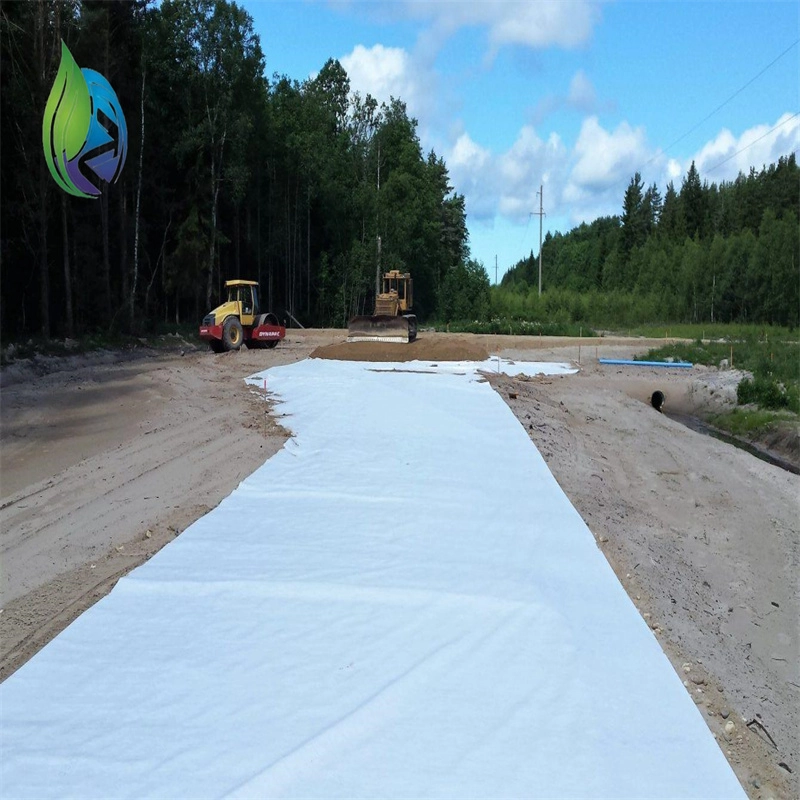
2. Unrolling and Placement
- Unroll in the specified orientation (often with the primary/warp direction aligned with traffic, per design)
- Lay the fabric smooth and wrinkle-free—wrinkles can create local weak lines
- Avoid dragging across sharp protrusions
- Reduce UV exposure and wind risk; where practical, cover within ~48 hours
3. Overlap and Anchoring (Keep Continuity)
Correct geotextile overlap anchoring prevents movement during aggregate placement:
- Typical overlaps: 300–600 mm (increase toward the upper end on very soft subgrades)
- Stagger end joints to avoid continuous lines of weakness
- Anchor using pins/staples or edge trenching, especially at shoulders, curves, and transitions
4. Cover and Aggregate Placement
Follow conservative geotextile cover thickness recommendations to avoid puncture and slippage:
- 100–150 mm compacted aggregate may be acceptable for low-traffic or temporary access
- 200 mm+ is commonly used where heavy construction traffic will operate on the base
Placement tips:
- Limit drop heights when dumping aggregate
- Avoid tracked equipment turning on exposed fabric
- Compact in layers to specification, keeping the geotextile fully covered
QA/QC Checklist for Predictable Pavement Life Extension
A disciplined geotextile QA QC checklist reduces rework and makes performance repeatable—especially when multiple crews are involved.
Before Delivery / Storage
- Confirm product grade matches the specification
- Check roll labels (batch, dimensions, date)
- Store rolls on a clean surface, protected from direct sunlight and jobsite sparks
Before Placement
- Verify subgrade elevation and compaction test results
- Confirm planned layout and overlap directions
- Brief the crew on overlap widths and anchoring method
During Placement
- Confirm overlap continuity and width
- Check panels are flat (no folds), then cover promptly
- Document any repairs to punctures or tears per project method statement

Product Strengths: Jinan Zhuyuan Woven Geotextile
For Shandong road reinforcement and broader East China projects, our woven geotextile for reinforcement and waterproofing is positioned as a field-practical solution for woven geotextile road reinforcement and geotextile for pavement life extension:
- High tensile strength for base/subgrade stabilization
- Low elongation and stable geometry under repeated loading
- Separation + filtration to help reduce pumping and base contamination
- Chemical and UV resistance suitable for local soils and installation conditions
- Works synergistically with geomembranes or waterproof coatings where a water barrier system is required (the fabric itself is not a membrane)
For grade-specific tensile values, opening size, and hydraulic properties, refer to the official datasheet for the selected grade.
Mini Case Example: Qilu Region Municipal Road Rehabilitation
A municipal road section in the Qilu region showed early rutting within 2–3 years, frequent rainy-season patching, and clear base contamination by subgrade fines.
Rehabilitation Approach
- Subgrade trimmed and compacted to spec
- Woven geotextile road reinforcement installed directly on subgrade
- Overlaps set to approximately ~400 mm, with edge anchoring
- A ~200 mm graded crushed-stone layer placed as initial cover, followed by normal pavement layers
Observed Outcome (Contractor/Owner Feedback After Two Winter Seasons)
- Less visible fines pumping during wet periods
- Improved ride quality with reduced rutting
- Reduced need for emergency maintenance versus prior years
FAQs (Overlaps, Cover Thickness, Woven vs. Nonwoven)
What overlap width is recommended on soft subgrades?
For most projects, 300–600 mm is common; on very soft subgrades, use 600 mm or more, or specify sewn/joined seams when required.
What is the minimum cover thickness over the geotextile?
Follow project specs. As a practical rule, 100–150 mm may suit light/temporary access, while 200 mm+ is typical for heavy construction traffic and to meet conservative geotextile cover thickness recommendations.
How soon should the geotextile be covered?
Cover as soon as practical—often within ~48 hours—to reduce UV exposure and wind disturbance.
Woven vs. nonwoven for roads—what’s the difference?
Use woven geotextile road reinforcement when reinforcement and separation are priorities and low-elongation load transfer matters. Nonwoven geotextiles are commonly chosen where filtration and drainage dominate (e.g., drains and some erosion control).
Summary and Next Steps
If you are dealing with weak subgrades, rutting, and repeat maintenance, woven geotextile road reinforcement is one of the most efficient upgrades you can add at the base–subgrade interface. Done correctly, it supports geotextile for pavement life extension by keeping the base clean, improving load distribution, and reducing differential settlement—without simply “over-designing” the asphalt.
To evaluate a Jinan Zhuyuan solution for your next Shandong road reinforcement project:
- Explore our product information: Woven Geotextile and Woven Geotextile for Reinforcement and Waterproofing
- Request a grade-specific datasheet and application recommendation
- Ask for samples to trial with your local aggregates
For quotations, samples, or technical support, contact us at sale01@zygeosynthetics.com or WhatsApp.
References
Ullah, S., Tanyu, B., Guler, E., Hoppe, E., & Akmaz, E. (2019). Evaluation of the long-term performance of woven geotextile used between base course and subgrade of a paved road. Transportation Research Record. https://doi.org/10.1177/0361198119827567
Hossain, M. S., & Schmidt, B. N. (2009). Benefits of using geotextile between subgrade soil and base course aggregate in low-volume roads in Virginia. Research report. https://www.semanticscholar.org/
Akram, W., & Reddy, K. S. C. (2016). Usage of woven geo-textiles in the construction of subgrade in flexible pavements. Indian Journal of Science and Technology, 9(44). https://doi.org/10.17485/IJST/2016/V9I44/105253
Kiptoo, D. K. (2016). An investigation of the effect of dynamic and static loading to geosynthetic reinforced pavements overlying a soft subgrade. Thesis/Dissertation. https://www.semanticscholar.org/
Grishma, T. (2019). Role of geotextile in highway stabilization. Technical paper (PDF). https://cgpit-bardoli.edu.in/wp-content/uploads/2019/02/Role-of-Geotextile-in-Highway-Stabilization.pdf
Upadhyaya, S., & Jaysawal, D. (n.d.). A comprehensive analysis of geotextile reinforcement in pavement design. International Journal article. https://un-pub.eu/