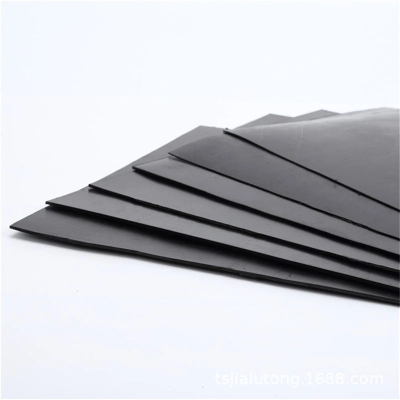
Railway Ballast Stabilization: A Practical Guide to Choosing Geotextile, Geogrid, or Geocomposite
A practical, field-ready guide to railway ballast stabilization—diagnose fouling or settlement, then choose filament geotextile, geogrid, or geocomposite to cut maintenance costs.
Railway ballast stabilization is ultimately about keeping the ballast layer clean, well-drained, and mechanically stable under years of intense traffic. In a typical trackbed cross-section (subgrade → sub-ballast → ballast), filament nonwoven geotextiles are commonly used as the separation and filtration layer, while geogrids provide reinforcement and ballast confinement.
When problems are mixed—or risks are high—geocomposite ballast protection combines both functions in one layer. We have designed this guide to follow a practical decision path: diagnose your trackbed problem, map it to the right geosynthetic solution, and understand the design and lifecycle impact on railway ballast stabilization.

Diagnose the Trackbed Before You Specify Materials
Successful railway ballast stabilization starts with disciplined diagnosis. Simply throwing rocks at the problem rarely works long-term. Most recurring trackbed issues fall into three distinct groups, and identifying them correctly is half the battle.
Mud-pumping and ballast fouling (hydraulic problem)
This is perhaps the most visible enemy of track stability. Common signs include:
- Dark slurry pumping up around sleepers after rainfall.
- Fines visible in crib ballast and shoulder zones, turning the ballast into a concrete-like mass.
- Faster track geometry loss and significantly higher tamping frequency.
- Low ballast permeability, where water lingers in the track structure long after storms have passed.
In these sections, the dominant mechanism is fine particle migration plus poor drainage. Dynamic loads pump subgrade fines upward into the ballast voids, while water trapped above weakens the subgrade. Your first priority here is separation and filtration. A robust filament geotextile is typically the correct base layer at the ballast–subgrade or sub-ballast–subgrade interface to cut off this migration path.
Lateral spreading and settlement (mechanical problem)
Sometimes the materials are clean, but the ground simply isn't strong enough. Typical indicators include:
- Ballast shoulder spread and loss of crib ballast over time.
- Permanent settlement over soft subgrade patches (ballast pockets).
- Local speed restrictions over “soft spots” or transition zones.
- Evidence of low bearing capacity (often low CBR values in geotechnical reports).
Here, drainage might be acceptable, but structural support is failing. A geogrid reinforcement layer is often more effective for railway ballast stabilization because it increases confinement and stiffness, acting like a snowshoe to distribute loads over a wider area.
Mixed hydraulic + mechanical problems
Many heavily loaded corridors face a "double whammy": pumping during wet periods and deformation under repeated load. For turnouts, transitions (embankment-to-bridge), and known weak areas, geocomposite ballast protection (a geogrid laminated to a filter geotextile) provides a dual function:
- Anti-pumping separation and filtration from the textile component.
- Tensile reinforcement and ballast confinement from the grid component.
A simple shortcut for railway ballast stabilization:
- Primarily hydraulic → Filament geotextile
- Primarily mechanical → Geogrid reinforcement
- Mixed / high-risk → Geocomposite ballast protection
Filament Nonwoven Geotextile: Separation and Filtration That Last
For railway ballast stabilization, our continuous-filament needle-punched nonwoven geotextiles are engineered to maintain separation and filtration performance under vibration, abrasion, and repeated loading. Unlike standard fabrics used in landscaping, these are built for heavy civil engineering.
Why continuous filaments matter
Our manufacturing process at Shandong Zhuyuan New Materials focuses on consistency and long-term durability. The difference lies in the fiber structure:
- Polymer drying and precision metering ensure raw material purity.
- Melt extrusion through spinnerets forms continuous, unbroken filaments.
- Fiber drawing and controlled cooling align the molecular structure for strength.
- Web formation via carding and cross-lapping creates a uniform mat.
- Needle punching using high-frequency loom systems mechanically interlocks the fibers.
- Thermal bonding adds dimensional stability.
Compared with short-fiber (staple) alternatives, a continuous-filament structure supports railway ballast stabilization by offering a stable pore structure, strong tear resistance, and reliable separation efficiency. It prevents the "blurring" of layers that leads to rapid track degradation.
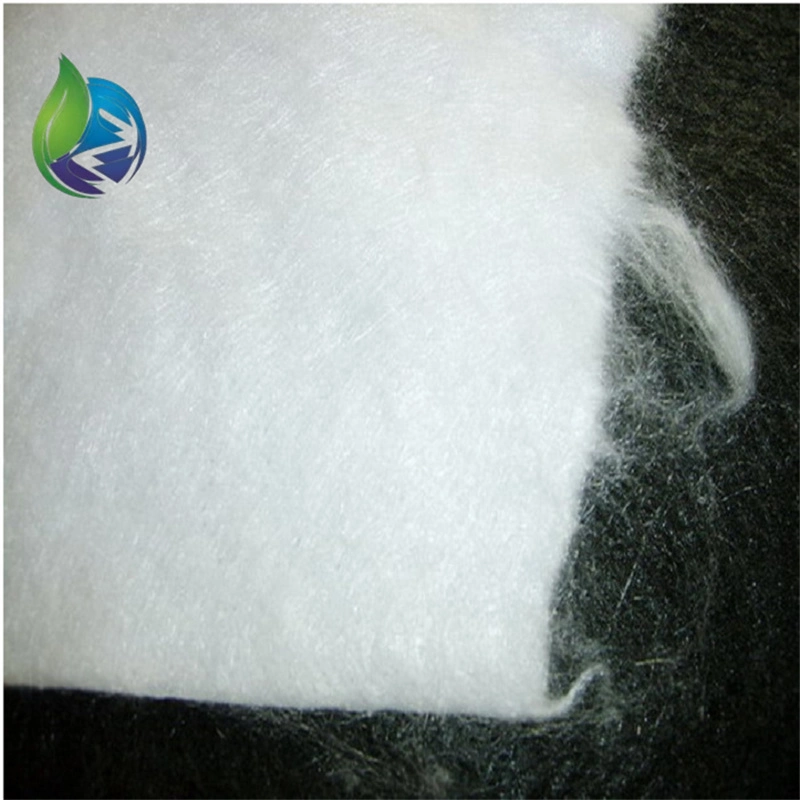
Practical weight (GSM) selection for railway ballast stabilization
Selecting the right weight is crucial. Too light, and it punctures during installation; too heavy, and you may be over-engineering. The table below summarizes typical ranges used in railway ballast stabilization (final selection should match CBR, design load, drainage targets, and construction method):
| Nominal weight (g/m²) | Thickness (mm) | Break strength (kN/m) | Typical rail use case |
|---|---|---|---|
| 150 | 1.3 | 4.5 | Light rail, sidings, separator above competent subgrade |
| 200 | 1.7 | 6.5 | Standard passenger lines, separator at sub-ballast interface |
| 300 | 2.4 | 9.5 | Mixed traffic, higher abrasion demand under ballast |
| 450 | 3.3 | 14 | Heavy freight corridors, wet formations, higher puncture demand |
| 600 | 4.1 | 19 | Very soft foundations and transition zones (working platform role) |
| 800 | 5.0 | 25 | Very soft foundations and transition zones (working platform role) |
In practice, filament geotextile supports railway ballast stabilization by delivering three core functions:
- Separation: Reduces upward migration of fines that foul ballast voids.
- Filtration: Allows water to pass freely while retaining soil particles (preventing pore pressure buildup).
- Drainage compatibility: Keeps drainage layers functional instead of clogged with silt.
Even the best material can underperform if installed poorly. We recommend focusing on these field practices:
- Surface Prep: Place geotextile on a smooth, well-prepared subgrade. Remove large boulders or debris that could cause immediate puncture.
- Overlaps: Use project-defined overlaps (often 300–500 mm, depending on subgrade CBR). In soft soil conditions, increase the overlap or sew the seams.
- Tensioning: Lay the fabric flat and pull it taut to avoid wrinkles, which can create weak points or fold over during backfilling.
- Water Management: Ensure the fabric directs water to an exit path (ditches, shoulders, outlets), rather than trapping it in a "bathtub."
Geogrid Reinforcement: Ballast Confinement and Load Distribution
Where the dominant issue is deformation or lateral spreading, a geogrid reinforcement layer serves as the skeleton of the trackbed.
The Mechanism of Interlock
Geogrids work differently from fabrics. Their primary function is interlock and confinement. When ballast aggregate is compacted over the grid, the stones partially penetrate the apertures (holes). The grid ribs restrain the stones from moving laterally. This "locking" effect creates a stiffened composite layer that resists settlement.
- Tensile reinforcement: Load is distributed over a wider area, lowering stress on weak subgrade.
- Long-term stability: Materials such as high-modulus polypropylene or coated polyester offer strong resistance to creep under sustained loading.
Key design points for railway ballast stabilization:
- Aperture Size: Match the aperture size to your ballast gradation (usually 30mm–65mm) for effective interlock.
- Grid Type: Biaxial geogrids are commonly preferred under ballast due to the multi-directional nature of stress distribution.
- Placement: Install at the ballast–sub-ballast interface or within the ballast layer itself, depending on the specific engineering design.
- Protection: Avoid over-stretching during installation and limit UV exposure during storage before cover is placed.

Geocomposite Ballast Protection: One Layer for Mixed Conditions
When hydraulic and mechanical problems occur together, using two separate layers can be labor-intensive and difficult to install without slippage. Geocomposite ballast protection offers a robust, unified approach to railway ballast stabilization.
In this system, a high-strength geogrid is factory-bonded to a nonwoven geotextile.
- The filament geotextile side typically faces the subgrade/sub-ballast to handle fines separation and filtration.
- The geogrid side faces upward to engage with the ballast for interlock and confinement.
Where do we see this used most often?
- Transition zones: Bridge approaches and cut/fill interfaces where stiffness changes abruptly.
- Soft patches: Areas with a history of repeated maintenance and rapid degradation.
- Turnouts and crossovers: Complex track structures with high impact loads and difficult drainage.
A factory-laminated system reduces installation complexity (one placement, one alignment) and lowers the risk of gaps that lead to pumping or loss of confinement. It essentially provides a "belt and suspenders" solution for the most critical sections of the railway.
Lifecycle Value: The Economics of Stabilization
Railway ballast stabilization is not just a construction box to check—it is a strategic maintenance decision. In many networks, the biggest costs are not the initial materials; they are possessions (track downtime), work windows, tamping cycles, undercutting, and ballast renewal volumes.
When filtration, separation, and confinement are designed correctly from the start:
- Cleaner Ballast: The aggregate stays clean for years longer, extending the time between expensive cleaning or replacement cycles.
- Open Drainage: Pathways remain open, preventing water-related track failures.
- Slower Deformation: Permanent settlement slows down, meaning tamping crews don't need to visit the same spot every month.
- Predictability: Maintenance becomes a planned activity rather than an emergency response.
Field and laboratory research has repeatedly linked geotextiles and geogrids to reduced ballast fouling and reduced permanent deformation. The ROI is typically realized within the first few years of operation through reduced maintenance interventions.
Geotextile vs. Geogrid vs. Geocomposite (Quick Comparison)
To summarize the selection process, here is how the three main solutions stack up:
| Item | Filament Geotextile | Geogrid Reinforcement | Geocomposite Ballast Protection |
|---|---|---|---|
| Primary Function | Separation & Filtration | Confinement & Reinforcement | Combined Filtration + Reinforcement |
| Best Fit | Mud-pumping, fouling, drainage issues | Settlement, lateral spreading, soft spots | Mixed conditions, high-risk zones, transitions |
| Limitations | Does not solve major bearing capacity issues alone | Does not provide filtration (fines control) | Higher initial material cost (but lower installation cost) |
| Common Placement | Ballast/sub-ballast/subgrade interfaces | Ballast–sub-ballast or within ballast | Same interface, laminated system |
Request Specs, Samples, or a Track-Specific Recommendation
Shandong Zhuyuan New Materials Co., Ltd. manufactures high-performance filament nonwoven geotextiles, biaxial geogrids, and customized solutions specifically for railway ballast stabilization. We understand that every mile of track has unique geological challenges.
- Explore our solutions:
For technical datasheets, material samples, or support with your specific track design:
- Contact person: Qiuy Lv
- Email: sale01@zygeosynthetics.com
- WhatsApp: Message us for a rail project quote
References
- Fernandes, G., Palmeira, E. M., & Gomes, R. C. (2008). Performance of geosynthetic-reinforced alternative sub-ballast material in a railway track. Geosynthetics International, 15(5), 311–321. https://doi.org/10.1680/GEIN.2008.15.5.311
- Indraratna, B., Khabbaz, H., Salim, W., & Christie, D. (2006). Geotechnical properties of ballast and the role of geosynthetics in rail track stabilisation. Ground Improvement, 10(3), 91–101. https://doi.org/10.1680/GRIM.2006.10.3.91
- Raymond, G. P. (1986). Installation factors that affect performance of railroad geotextiles. Transportation Research Record. Search Article
- Bathurst, R., & Raymond, G. (1987). Geogrid reinforcement of ballasted track. Transportation Research Record. Search Article
- Hussaini, S. K. K., Indraratna, B., & Vinod, J. S. (2016). A laboratory investigation to assess the functioning of railway ballast with and without geogrids. Transportation Geotechnics, 6, 95–104. https://doi.org/10.1016/J.TRGEO.2016.02.001
- Federal Highway Administration. (2006). Geosynthetic Design and Construction Guidelines (Geotechnical Engineering Circular No. 4). FHWA Publication
- Railway Technical Research Institute (RTRI). (2018). Press release: Ballast stabilization pilot (test section report). RTRI Report