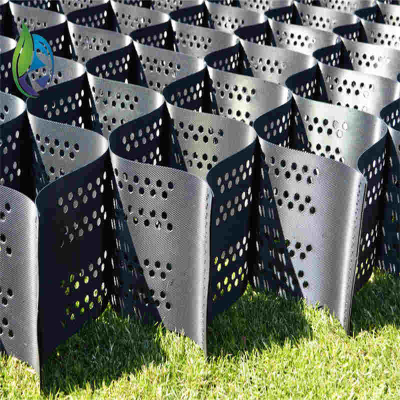
A Greener Parking Lot That Still Drives Like Pavement
Urban sites are being asked to do more with the same square footage: stay drivable for vehicles, reduce puddling after storms, and look like landscape—not pavement. The most practical way to get there is a permeable paving system that combines a stable base, a proper separation layer, and a turf-friendly surface. A proven approach is the white geotextile underlayment + plastic grass paver stack. This system turns parking bays, overflow lots, fire lanes, and access routes into permeable grass pavers that support vehicle loads while letting water infiltrate.
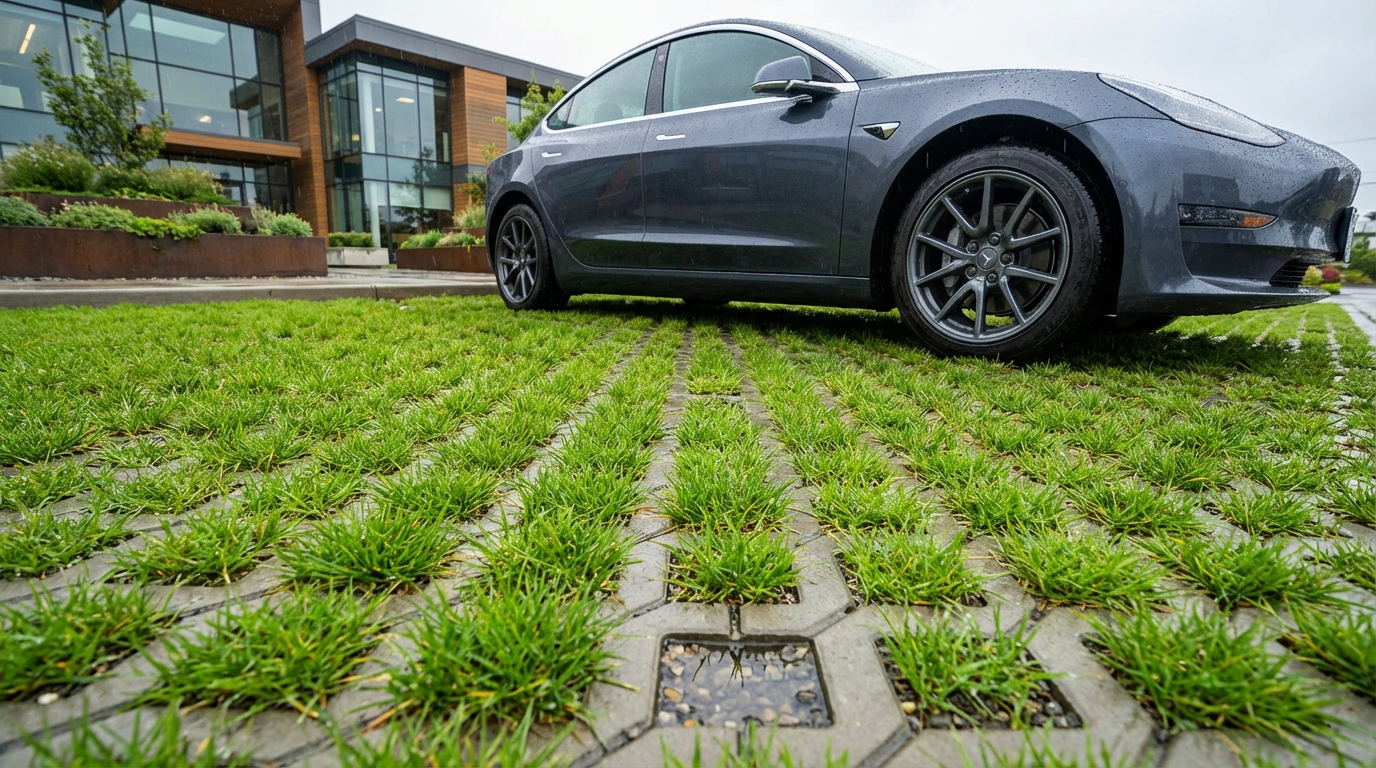
What buyers actually need from permeable parking
Owners and project teams rarely ask for "a plastic grid." They ask for specific outcomes that solve site engineering challenges. The demand usually stems from local stormwater regulations or a desire to maximize green space without sacrificing parking capacity.
Here is what matters most to developers and contractors:
- Less runoff and ponding during heavy rain to manage stormwater on-site.
- A drivable surface that supports daily cars, service vehicles, and (where required) emergency access fire trucks.
- A greener visual that blends into the landscape and helps reduce the urban heat island effect.
- A realistic maintenance plan—not a surface that needs specialty vacuum equipment every month.
Compared with hard pavements, permeable grass pavers keep the site looking like a lawn while still functioning like infrastructure. And compared with porous concrete or asphalt, a plastic grass paver surface offers a distinct advantage: it can be repaired locally by simply swapping modules instead of cutting, patching, and curing large sections of pavement.
Use-case spotlight: a permeable green parking lot
A permeable green parking lot works when the performance targets are defined early in the design phase. Before you pick a module pattern or cell size, confirm the basics:
- Hydraulic goal: Do you need fast vertical flow through the surface? Is the subbase sized to temporarily store stormwater (detention) or infiltrate it back into the ground (retention)?
- Load requirement: Will this handle only passenger vehicles, or do you need to support 20-ton service trucks and designated emergency lanes?
- Green coverage expectation: Many owners consider ≥70% turf coverage the minimum visual requirement. Well-built systems can exceed 90% coverage.
- Local approvals: Always confirm whether a driveable turf solution is accepted as an all-weather surface for your specific use case by local municipal codes.
When these targets are clear, it becomes easier to engineer each layer of the permeable paving system—especially the separation and filtration details that ensure longevity.
The engineered stack (and why each layer matters)
A reliable plastic grass paver installation is not “just lay a grid on soil.” It is a carefully layered system where every component has a specific job to do.

1) Subgrade + aggregate subbase: strength and storage
- Subgrade: This is the native soil. You must remove unsuitable soils, then level and compact the ground to the project specification (often around 95% Proctor in practice).
- Aggregate subbase: This layer consists of clean, open-graded aggregate. It functions as a temporary reservoir for water and a load-distribution layer for vehicles.
This is where most long-term performance is won: you need enough thickness for the load class, enough void space for the design storm, and good compaction control.
2) White geotextile underlayment: separation and filtration
The white geotextile underlayment is the “quiet” layer that protects permeability over time. Without it, the system is prone to clogging from below.
In a plastic grass paver parking lot, it is commonly used to:
- Separate native soils from the stone layer so fines don’t migrate upward into the clean aggregate.
- Filter stormwater flow and reduce subbase contamination.
- Preserve infiltration by helping keep voids open for water movement.
For a geotextile underlayment for pavers in drivable applications, project teams often specify a permeable, needle-punched nonwoven fabric and select it based on permittivity/flow, AOS, and puncture strength (ASTM methods are commonly referenced in North America). Placement can be between subgrade and subbase, or as required by your cross-section—selection should match your soil conditions and the role (separation vs. protection).
3) Plastic grass paver layer: the load-bearing green surface
At Zhuyuan, our plastic grass paver and plastic grass grid systems are engineered specifically for drivable, permeable surfaces. We focus on durability and ease of installation.
Typical product characteristics include:
- Material: High-quality recycled HDPE (High-Density Polyethylene) or PP (Polypropylene). HDPE is preferred for its balance of rigidity and flexibility.
- Cell size: Typically about 50–70 mm high, providing enough depth for root establishment.
- Permeability structure: An open-grid design (many applications target ≥90% open-cell rate at the surface) ensures maximum water infiltration.
- Compressive performance: This is project-dependent. Our product lines support anything from light vehicle use to high-load designs (specifications may reach up to 200-250 tons/m², depending on the model and filled test conditions).
- Climate tolerance: Commonly rated for -40°C to +90°C, handling freeze-thaw cycles without cracking.
- UV resistance: Yes, UV stabilizers are added to prevent degradation from sunlight.
- Service life: HDPE systems with anti-aging additives are commonly designed for long-term outdoor exposure, often exceeding 10+ years.
Because the modules interlock securely, a plastic grass grid distributes wheel loads across many cells instead of concentrating stress on the turf crowns, preventing rutting.
4) Rootzone + turf: keep it permeable, keep it alive
Healthy grass is a performance feature, not just decoration. The root system helps stabilize the fill. For turf-filled permeable grass pavers:
- Use a free-draining rootzone (many contractors work with sand/soil blends; avoid high-clay mixes that seal the surface).
- Fill cells fully, then maintain a slight freeboard (space between soil top and paver top) to reduce tire shear on the grass blades.
- Choose grasses suited to the local climate and maintenance level; common options include Bermuda, Fescue, and Ryegrass.
Installation checklist (the steps that prevent failures)
Most underperforming permeable paving system projects fail due to installation shortcuts, not because of the plastic grass paver itself. Following a strict protocol ensures success.
- Excavate to design depth and remove weak organic materials.
- Prepare and compact subgrade; shape grades as required for drainage.
- Place aggregate subbase in lifts and compact to specification to prevent settling later.
- Install the white geotextile underlayment:
- Lay the plastic grass paver modules starting from a straight reference line (like a curb) and lock the joints securely.
- Infill with rootzone (or gravel where specified), then lightly compact or water to settle.
- Seed or install turf, water thoroughly, and protect the area during establishment.
- Open to traffic gradually—avoid heavy turning movements until the turf is fully rooted.
For planning purposes, modular plastic grass paver projects often install at about ~200 m²/day with 2–3 workers, depending on site access and base work preparation.
How it compares to other permeable surfaces
A plastic grass paver surface is not meant to replace every pavement type. It is best used where you want green coverage without losing drivability.
| Decision point | Plastic grass paver + white geotextile underlayment | Permeable concrete/asphalt | Traditional Concrete |
|---|---|---|---|
| Appearance | Green, lawn-like surface | Conventional pavement look (grey/black) | Grey, hard surface |
| Infiltration pathway | Grid + rootzone + stone reservoir | Porous matrix + stone reservoir | None (Runoff) |
| Maintenance style | Turf care + occasional top-up | Vacuum/jet cleaning to reduce clogging | Sweeping / sealing |
| Repairs | Replace local modules easily | Cut, patch, cure (expensive) | Cut, patch, cure |
| Heat island impact | Typically lower due to turf evapotranspiration | Higher than turf surfaces | High heat retention |
Where this system fits best
A white geotextile underlayment + plastic grass paver stack is widely used for:
- Commercial green parking lots and overflow parking areas.
- Fire lanes and emergency access routes (requires proper engineering and approvals).
- Residential driveways and shared courtyards.
- Park maintenance access roads.
- Podium decks/roof landscapes (with structural checks and suitable lightweight options).
FAQ (buyer-focused)
Q: Can a plastic grass paver parking lot handle vehicles every day?
A: Yes. A correctly designed base combined with the right plastic grass paver model creates a stable, drivable surface suitable for regular vehicle use. The key is the base preparation.
Q: Why is a white geotextile underlayment recommended under permeable grass pavers?
A: It acts as a crucial separation layer. It helps keep the stone layer from clogging with soil fines from the subgrade, which supports long-term infiltration performance and stability.
Q: What’s the minimum order quantity?
A: Our typical MOQ is about 300 m², but we are flexible depending on current stock levels.
Q: Do you support OEM/ODM?
A: Yes. We support OEM/ODM for specific project requirements, including color or mold modifications. We can also supply from stock for faster delivery where applicable.
Request specs, pricing, or samples
If you are designing a permeable paving system for parking, access roads, or landscaped hardscapes, our engineering team can help match the right plastic grass paver model, base thickness, and white geotextile underlayment approach to your site conditions.