Designing a Reliable Landfill Liner: HDPE Geomembrane + Woven Geotextile
Modern landfills are built under two competing realities: tighter leachate-control expectations and tougher construction environments (coarse drainage gravel, steep slopes, and constant equipment traffic). A proven, field-friendly approach is the HDPE geomembrane woven geotextile landfill liner—a composite arrangement where an HDPE geomembrane provides the hydraulic barrier and a woven geotextile protects and stabilizes the system during construction and long-term service.
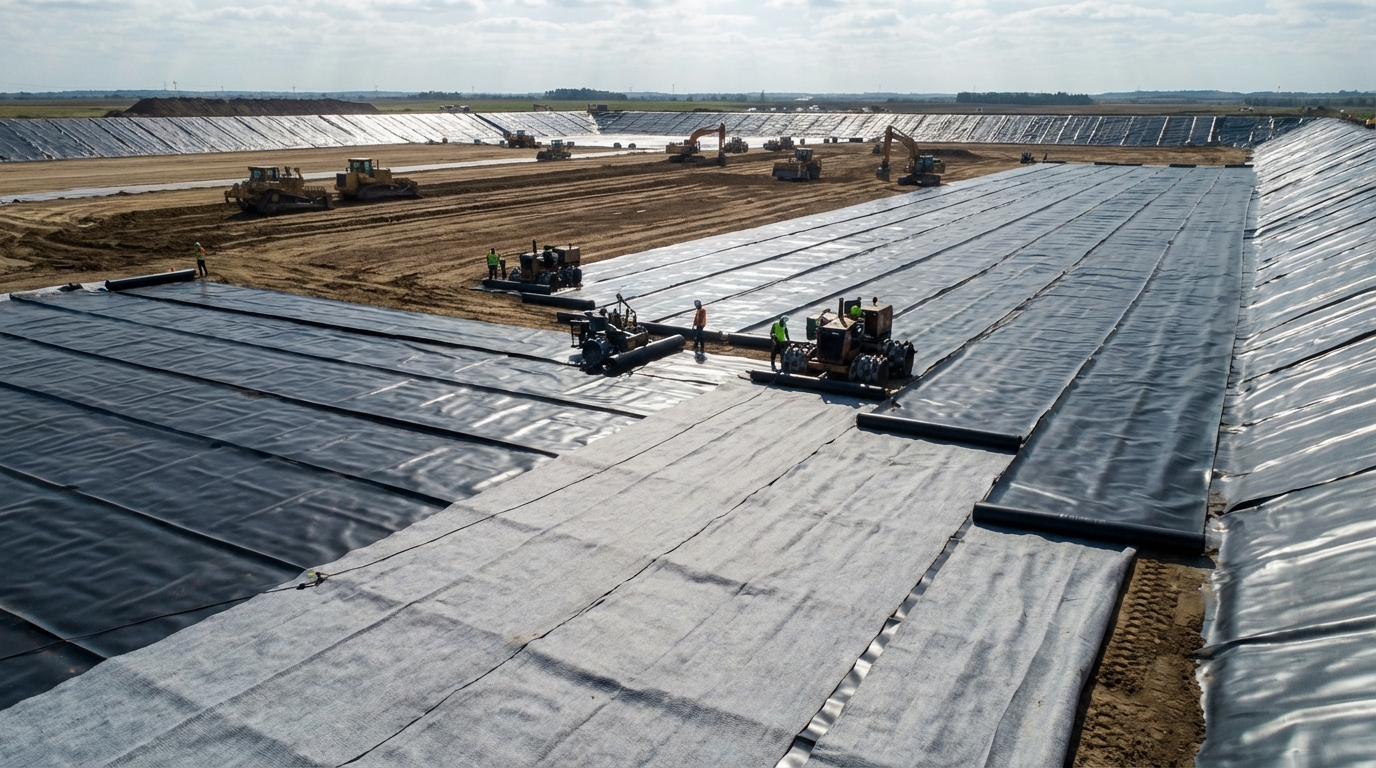
Typical landfill composite liner configuration (what we commonly supply)
The exact stack depends on local regulations and risk level, but the structure below reflects what many owners and EPC teams specify for a landfill composite liner HDPE geotextile package.
| Layer | Typical option (example) |
|---|---|
| Subgrade | Compacted clay or GCL (geosynthetic clay liner) |
| Barrier | HDPE geomembrane 1.5 mm |
| Protection | Woven geotextile 300 g/m² |
| Drainage | Geonet or structured drainage sheet (plus collection pipes) |
| Termination | Anchor trench at perimeter + cover soil or ballast |

Why pair an HDPE geomembrane with a woven geotextile?
HDPE geomembrane: the hydraulic barrier
An HDPE geomembrane is selected for its extremely low permeability and strong chemical resistance—key attributes for leachate containment. From our standard range used in containment projects, typical technical expectations include:
- Thickness: 0.75–2.5 mm
- Tensile strength: ≥ 25 kN/m
- Puncture resistance: ≥ 600 N
- UV resistance: > 90% after 10,000 hours of exposure
These values help designers match an HDPE geomembrane woven geotextile landfill liner to mechanical loads, exposure conditions, and service-life targets.
Clay or GCL beneath: intimate contact matters
A compacted clay liner or GCL under the HDPE geomembrane improves overall system reliability because the low-permeability layer helps limit leakage even if localized defects occur. Many liner rules emphasize this “intimate contact” concept in composite systems (see NY example in the references).
Woven geotextile: protection + reinforcement
A woven geotextile brings high tensile strength and low elongation, which is valuable when:
- Coarse gravel is placed above the liner system
- Slopes are steep and interface stability is critical
- Construction traffic increases abrasion and snagging risks
When subgrade conditions are particularly rough, many projects add a nonwoven cushioning layer or sand blinding—then keep the woven geotextile as the rugged work layer for construction sequencing.

Material selection: practical thickness and fabric guidance
HDPE geomembrane thickness (rule-of-thumb)
Many municipal landfill designs commonly specify 60–80 mil (≈1.5–2.0 mm) HDPE geomembrane for the barrier layer.
| HDPE thickness | Typical use case | Notes |
|---|---|---|
| 1.0 mm | Temporary cells, low-head ponds, caps | Use only where loads and risk are low |
| 1.5 mm | Standard municipal cells, lagoons | Widely used “default” thickness |
| 2.0 mm | Steeper slopes, higher mechanical risk | Added puncture and stress margin |
Woven geotextile selection (200–400 g/m²)
For a woven geotextile protection layer in landfill work, 200–400 g/m² is common, with selection driven by aggregate angularity, traffic, and slope conditions.
Buyer tip: When specifying an HDPE geomembrane woven geotextile landfill liner, request factory QC documentation and traceability (roll numbers, batch IDs) so field records can tie back to production testing.
Installation steps that protect performance (and prevent costly rework)
A landfill liner is only as good as its field execution. A typical HDPE geomembrane installation flow looks like this:
- Subgrade prep (clay/GCL), trim to grade, remove sharp debris
- Deploy HDPE geomembrane panels with controlled slack (avoid overstress)
- Run daily trial welds for each machine/shift
- Weld seams and complete destructive peel/shear checks per project criteria
- Perform 100% non-destructive testing (NDT) of seams (vacuum box and/or air pressure)
- Place woven geotextile carefully (avoid dragging across exposed liner)
- Install drainage layer (geonet/drainage sheet) and collection components
- Place cover soil and complete anchor trench backfill
Quick checklists (high-impact)
- Subgrade: smooth, compacted, rock-free; add sand or cushioning geotextile where needed.
- Seaming: clean overlap, stable welding parameters, documented seam map.
- Geotextile placement: 150–300 mm overlaps, sandbags for temporary restraint, no metal pins directly on HDPE.
Common failure pattern: puncture during gravel placement. Mitigation: correct fabric weight, controlled dumping, and disciplined traffic management over the woven geotextile.
Procurement guidance for an HDPE geomembrane woven geotextile landfill liner
To compare suppliers consistently, specify:
- HDPE geomembrane resin expectations (virgin resin with stabilizers), thickness, roll width (up to 8 m is available), and UV package
- Woven geotextile mass (GSM) and minimum tensile/puncture requirements
- Field welding method and QA/QC plan (trial welds, destructive tests, 100% NDT)
- Third-party test reports when required by the owner or regulator
ZY Geosynthetics supplies project-matched liner materials that combine into complete packages:
FAQ
Is woven or nonwoven geotextile better for landfill liner protection?
Use woven geotextile when reinforcement, abrasion resistance, and slope stability dominate. Use nonwoven (or sand) when cushioning against sharp subgrade is the primary need. Many projects combine both.
What thickness HDPE geomembrane is typical for municipal landfills?
A common range is 1.5–2.0 mm (60–80 mil), subject to local requirements and risk.
How are HDPE geomembrane seams tested on site?
With daily trial welds plus destructive peel/shear tests, followed by 100% seam NDT (vacuum box and/or air pressure) with clear records and seam maps.
Summary and Contact
A well-designed HDPE geomembrane woven geotextile landfill liner delivers a dependable containment barrier while reducing puncture and construction damage risk—especially when paired with a smooth subgrade, disciplined seam welding, and documented QA/QC.
If you share your project basics (cell area, slope, drainage aggregate type, and service expectations), we can recommend a practical liner package and specification wording.
Contact
sale01@zygeosynthetics.com
+86 15615641112 (WhatsApp available)
References
- New York State Department of Environmental Conservation. (n.d.). 6 NYCRR Part 363-6.6—Liner system and final cover requirements. https://www.law.cornell.edu/regulations/new-york/6-NYCRR-363-6.6
- Müller, W. (2006). HDPE Geomembranes in Geotechnics. Springer. https://doi.org/10.1007/978-3-540-37288-2
- Marcotte, B., & Fleming, I. (2021). Design guidance for protection of geomembrane liners in landfill applications. Canadian Geotechnical Journal. https://doi.org/10.1139/cgj-2021-0222
- Hsuan, Y., & Koerner, R. (1998). Antioxidant depletion lifetime in high density polyethylene geomembranes. Journal of Geotechnical and Geoenvironmental Engineering, 124(6), 532–541. https://doi.org/10.1061/(ASCE)1090-0241(1998)124:6(532)
- Averesch, U. B., & Schicketanz, R. T. (n.d.). Recommendations for new installation procedures of geomembranes in landfills. International Geosynthetics Society Library. https://library.geosyntheticssociety.org/wp-content/uploads/resources/proceedings/3.01%20Recommendations%20for%20new%20installation%20procedures%20of%20geomembranes%20in%20landfills.pdf
- Waste Management. (n.d.). Landfill liner system—Environmental protection overview. https://www.wm.com/us/en/facilities/hillside-landfill/environmental-protection/landfill-liner-system
- Solmax. (n.d.). Geomembrane products installation QA manual (excerpt). https://manuals.plus/m/ea3e9edaff18a8bce774caa273b4efe17e4b123be707cdf191d1c3d3a36d97e5