
Top 5 Uses of HDPE Geomembranes in Mining and Waste—Built to Stop Leaks
Leakage is one of the most expensive risks in mining and waste management. A small seepage path in a tailings basin, a landfill cell, or a wastewater lagoon can lead to groundwater impacts, operational shutdowns, regulatory penalties, and significant long-term remediation costs. That is why HDPE Geomembranes are widely specified as the primary barrier in modern containment systems. When properly selected and installed, HDPE Geomembranes deliver extremely low permeability (commonly cited at ≤1×10⁻¹³ m/s in practice), strong chemical resistance, and dependable long-term performance in buried applications.

At Zhuyuan New Materials Co., Ltd., we manufacture smooth and textured HDPE Geomembranes in 0.5–3.0 mm thicknesses. In mining and waste projects, 1.0–2.0 mm is common, while 1.5–2.0 mm is frequently specified for tailings ponds, heap-leach pads, and heavy-duty landfill liner systems.
1) Landfill Liners and Caps
Modern landfills rely on layered barrier systems to isolate waste from soil and groundwater. In these systems, HDPE Geomembranes are typically the primary low-permeability layer used in both the base liner and, in many designs, the final cover (cap).
What the liner and cap are designed to do
- Base liner: Blocks leachate migration into the subgrade and aquifers.
- Leachate collection support: A smooth geomembrane surface helps liquids drain toward collection pipes rather than pooling.
- Final cap: Limits rain infiltration, helps manage gas, and improves long-term stability.
Why designers choose HDPE Geomembranes here
- Very low permeability across large panels and long seam runs.
- Chemical resistance to common landfill leachate constituents.
- Weldable seams that can be tested to confirm continuity.
- Strength under settlement loads, especially when protected with a cushion layer.
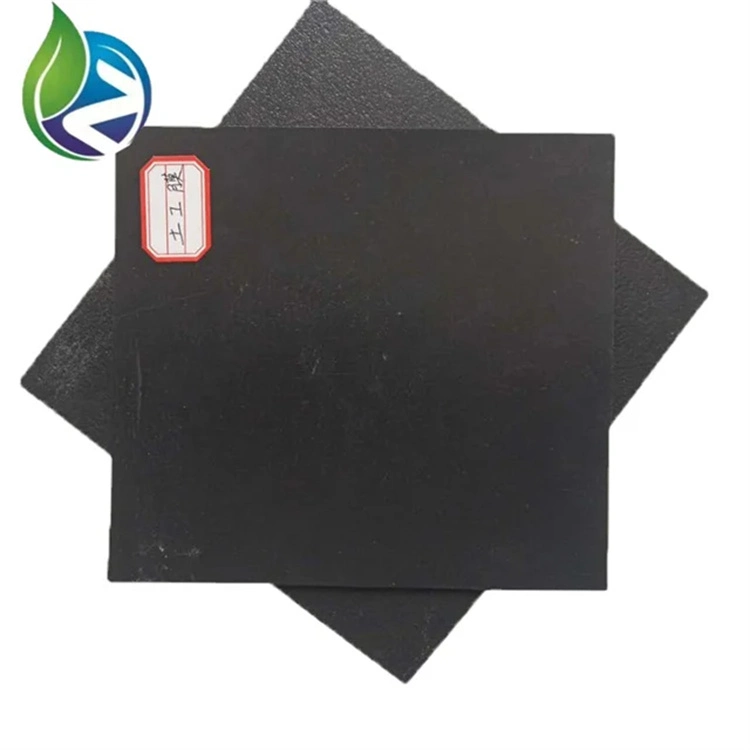
Typical selection: Many municipal and industrial landfills use 1.5–2.0 mm smooth HDPE Geomembranes for the base liner, paired with compacted clay or a geosynthetic clay liner (GCL), plus nonwoven geotextile cushioning.
Common risks and practical controls
- Subgrade defects: Use a smooth, well-compacted base and a geotextile cushion.
- Seam defects: Require qualified hot-wedge or extrusion welding and 100% non-destructive seam testing (e.g., air pressure or vacuum box, where applicable).
- Anchor trench issues: Detail anchors and terminations to resist wind uplift during construction and long-term slope movement.
Internal product link: HDPE geomembrane.
2) Tailings Ponds and Process Water Storage
Tailings storage facilities (TSFs) and process water ponds often contain slurry and chemically variable water. For these high-consequence basins, HDPE Geomembranes are commonly used to minimize seepage and support compliance.
What the liner does in tailings containment
- Reduces seepage through the basin floor and slopes.
- Separates tailings water from surrounding soil and groundwater.
- Supports controlled decanting and water recovery.
Selection tips: smooth vs. textured
- Textured HDPE Geomembranes are often preferred on side slopes to increase interface friction and improve slope stability.
- Smooth HDPE Geomembranes can be advantageous on floors where welding access and drainage details matter.
Typical thickness: 1.5–2.0 mm HDPE Geomembranes are widely used for tailings ponds, with cushioning geotextiles or composite systems where subgrade conditions are rough.

Risk points and mitigation
- Differential settlement: Select liners with sufficient elongation and pair with staged filling plans.
- Puncture from rock or coarse materials: Use nonwoven geotextile underlay, and avoid placing sharp aggregate directly on the liner.
- Long seam lengths: Implement strict installation QA/QC (trial seams, parameter logging, destructive samples at defined frequency).
3) Heap-Leach Pads
Heap-leach pads are engineered to percolate reagents through ore heaps and collect “pregnant” solution for processing. In this environment, HDPE Geomembranes form the critical containment layer under high loads and chemical exposure.
What HDPE Geomembranes do on a leach pad
- Prevent downward migration of leaching solutions.
- Enable solution collection and recirculation through drainage and piping.
- Provide a weldable barrier across the full footprint.
Typical build-up (bottom to top): prepared subgrade → cushion (often geotextile) → textured HDPE Geomembranes → drainage layer and pipes → ore.
Practical design controls
- Slope stability: Use tested interface friction values and match surface type (textured vs. smooth) to slope geometry.
- Chemical compatibility: Confirm liner performance against project-specific solution chemistry and operating temperatures.
- Leak detection (when required): Consider double-liner or leak detection layers for higher-risk designs.
Related product page: geomembrane.
4) Leachate and Wastewater Lagoons & Biogas Systems
Leachate ponds, industrial wastewater lagoons, and biogas digesters need consistent containment despite changing chemistry, temperature cycles, and sometimes partial UV exposure. HDPE Geomembranes are widely used because they balance impermeability, durability, and reliable welded seams.
What these systems typically require
- Long-term low-permeability containment.
- UV-stabilized performance during installation and any exposed service.
- Robust detailing around penetrations, anchors, and interfaces.
Typical thickness: 1.0–1.5 mm HDPE Geomembranes are used in many lagoons, with thicker liners selected where mechanical loads, exposure, or chemical aggressiveness is higher.
Detailing that prevents avoidable leaks
- Pipe penetrations/flanges: Seal micro-gaps with compatible sealants, then weld a geomembrane patch for redundancy.
- Thermal movement: Allow controlled slack and anchor the perimeter correctly to reduce stress and wrinkling.
- Protection layers: Where puncture risk exists, pair HDPE Geomembranes with a cushioning geotextile.
Internal link: geotextile.
5) Secondary Containment for Tanks and Transfer Areas
Secondary containment is the “last line” around chemical tanks, loading areas, and process transfer zones. Here, HDPE Geomembranes provide a continuous, weldable floor (and sometimes wall lining) inside bunded or curbed areas.
Why HDPE Geomembranes fit secondary containment
- Fast deployment via prefabrication or efficient field welding.
- Wide chemical resistance for many industrial liquids.
- Compatibility with testing approaches (including spark testing when conductive systems are specified by the project).
Typical thickness: 1.5–2.0 mm HDPE Geomembranes are common when traffic, impact, or higher puncture risk is expected.
How to Choose the Right HDPE Geomembrane (Fast Checklist)
Choosing HDPE Geomembranes is not only about price—performance depends on matching the liner to the site conditions and enforcing installation quality.
- Define exposure: chemistry, concentration, temperature range, and whether the liner is buried or exposed.
- Confirm mechanical demands: subgrade roughness, puncture risk, settlement, and slope geometry.
- Pick surface type: smooth for drainage and welding efficiency; textured where higher friction is needed.
- Select thickness: many mining and waste designs use 1.5–2.0 mm HDPE Geomembranes; lagoons often start at 1.0–1.5 mm.
- Verify manufacturing QC: thickness control, surface integrity, and inspection for holes, bubbles, or uneven thickness.
- Plan field QA/QC: qualified welders, defined seam tests, and a clear repair protocol.
To review specifications or request roll-by-roll documentation for HDPE Geomembranes, visit our HDPE geomembrane page.
FAQs (Mining and Waste Projects)
What thickness is typical for a tailings pond liner?
Many projects specify 1.5–2.0 mm HDPE Geomembranes, adjusted for settlement, chemistry, and local requirements.
When should I use smooth vs. textured liners?
Smooth liners help drainage and simplify seam welding; textured HDPE Geomembranes are often used on slopes to improve interface friction.
How are seams tested?
Quality programs commonly combine visual checks, non-destructive testing (such as vacuum box or air-pressure testing for dual-track seams), and periodic destructive sampling.
Can HDPE Geomembranes handle harsh mining solutions?
They are widely used in mining containment because HDPE offers strong chemical resistance; compatibility should still be verified against the project’s specific fluids and temperatures.
About Zhuyuan New Materials (Manufacturing and Project Support)
Zhuyuan New Materials Co., Ltd. supplies smooth and textured HDPE Geomembranes, composite geomembranes, and geotextiles for landfill, mining, and industrial containment projects. Our production follows an engineering-oriented workflow—high-temperature extrusion, automated thickness control, optional texturing, controlled cooling, and laboratory testing—so performance remains consistent from roll to roll.


