Stop Water Pressure Before It Starts: Tunnel & Roadbed Drainage with an HDPE Geonet Core
Hidden water buildup is one of the fastest ways to shorten the service life of a tunnel lining or road subgrade. When seepage has nowhere to go, it creates hydrostatic pressure, weakens the supporting layers, accelerates cracking, and drives maintenance costs up far earlier than planned. Our HDPE geotextile geonet composite for drainage (also known as Tri-dimension Composite Geonet) is engineered to manage that risk with one integrated layer: filtration, separation, and high-capacity in-plane drainage. In many projects, this composite allows you to replace thick sand or gravel drainage layers—saving excavation depth, aggregate tonnage, and installation time while ensuring predictable, factory-controlled hydraulic performance.

Why Drainage is a Make-or-Break Detail in Tunnels and Roadbeds
Water is persistent. In underground and transportation infrastructure, it will find joints, pores, and interfaces—then stay trapped if the drainage path is too slow or too long. Efficient water management is critical in modern infrastructure to prevent structural failures.
Tunnel Drainage System: Reduce Pressure, Protect Waterproofing
In a tunnel drainage system, uncontrolled water behind the lining can lead to severe issues:
- Hydrostatic pressure acting on the lining and joints, potentially causing structural instability.
- Extra stress on waterproofing membranes, significantly increasing the risk of leakage.
- Long-term concrete deterioration and cracking due to saturation.
A reliable drainage layer must move water rapidly in-plane toward collection pipes and keep working under high confinement. This is where our HDPE geotextile geonet composite for drainage excels. The drainage core creates continuous flow channels, while the geotextile filter prevents fines from entering and clogging the core.

Roadbed Drainage Solutions: Protect Bearing Capacity
In roadbed drainage solutions, excess water inside the base or subbase can be equally destructive:
- Reduce shear strength and overall bearing capacity of the road foundation.
- Drive frost heave and thaw weakening in cold regions, leading to pavement deformation.
- Cause rutting, cracking, and pumping of fines under heavy traffic loads.
A traditional approach uses 200–300 mm of granular drainage material. While functional, it requires more excavation, significant quarry aggregate, more truck trips, and relies on variable field placement quality. Our composite provides a thinner, more efficient drainage layer while simultaneously improving separation between soil strata.
What the HDPE Geotextile Geonet Composite for Drainage Actually Is
Our HDPE geotextile geonet composite for drainage is a high-performance geosynthetic built from:
- Three-dimensional HDPE Geonet Core:
- Bonded Nonwoven Geotextile Layer(s):
In some project configurations, one side may be paired with an impermeable geomembrane, combining waterproofing and drainage into one coordinated system. This integrated design minimizes material usage and simplifies installation.
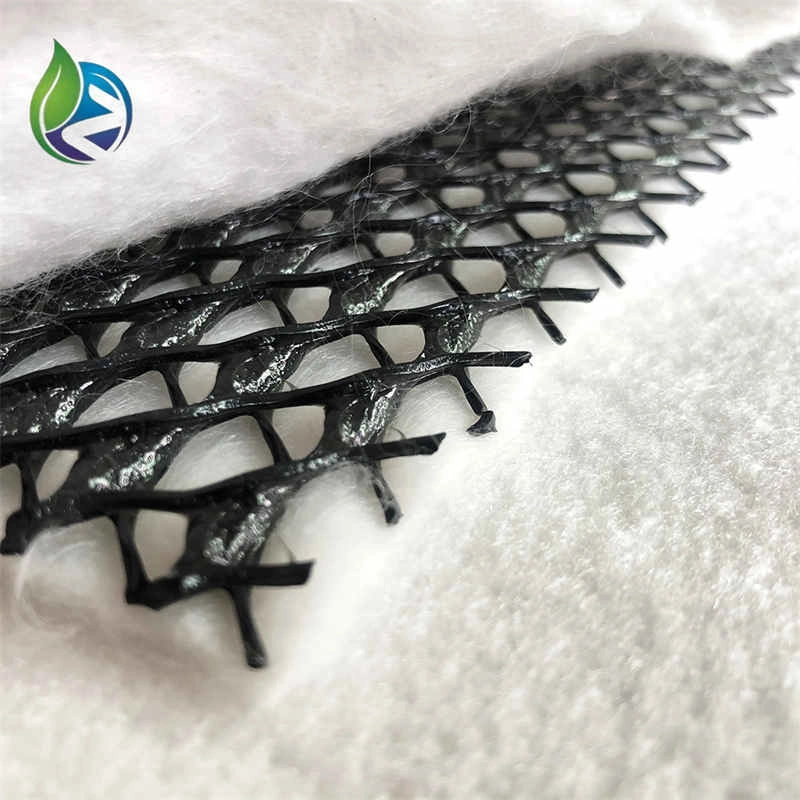
Why this structure matters: The HDPE geotextile geonet composite for drainage keeps drainage, filtration, and separation working together. Instead of relying on field-placed aggregate gradation and compaction quality, the flow paths are defined by the tested core geometry and protected by the filter fabric.
To see our product category and application scope, visit: Composite Drainage Net
Key Technical Features and Benefits
Beyond the basic structure, our composite is engineered for demanding civil environments. Key features include:
- Excellent Drainage Capacity: The 3D core ensures high flow rates even under significant load, enabling rapid water discharge and pressure relief.
- High Tensile and Compression Strength: Engineered from virgin HDPE, the composite resists deformation under heavy loads and long-term stress, maintaining its hydraulic properties over time.
- Chemical and UV Resistance: The material is stable against acids, alkalis, and UV exposure, making it ideal for both buried applications (like landfills) and exposed edges.
- Lightweight and Easy to Install: Rolls are easy to cut, transport, and deploy, which directly reduces labor and equipment costs compared to hauling gravel.
How One Drainage Layer Supports Two Scenarios
Behind Tunnel Linings: Fast In-Plane Flow
Placed behind tunnel linings, the HDPE geotextile geonet composite for drainage is commonly used to:
- Channel seepage horizontally to collection pipes.
- Reduce standing water and relieve hydrostatic pressure.
- Help keep filtration stable so the drainage core stays open.
When tunnel waterproofing requires a membrane layer, our drainage materials can be coordinated with geomembrane systems depending on the project design. Learn more about our geomembrane products here: Geomembrane
Under Pavements and Embankments: Thinner Sections
Installed between the foundation and subbase, the composite can:
- Drain water quickly and integrate into edge drainage systems.
- Block capillary water movement under load.
- Reduce fines migration between layers (separation function).
For many roadbed drainage solutions, this means the same drainage goal is achieved with less excavation and far less aggregate handling.
Gravel Replacement: Where the Savings Come From
Replacing a thick granular drainage layer with an HDPE geotextile geonet composite for drainage is not just about material substitution—it fundamentally improves logistics and construction sequence.
Typical Comparison (Conceptual)
| Item | Traditional Gravel/Sand Drainage Layer | HDPE Geotextile Geonet Composite |
|---|---|---|
| Drainage Mechanism | Flow through aggregate voids (field-dependent) | High in-plane flow through 3D channels |
| Thickness (Typical) | 200–300 mm | Thin composite layer + minimal bedding |
| Excavation | Deeper to fit aggregate thickness | Reduced excavation depth |
| Material Sourcing | High aggregate volume | Factory-made rolls |
| Construction Speed | Slower (place/spread/compact) | Faster (roll out, overlap, cover) |
| Quality Consistency | Varies with workmanship and gradation | Consistent product structure |
Illustrative Road Section Example (Material-Only)
Consider a 1 km long, 6 m wide section (area = 6,000 m²):
If a 300 mm gravel drainage layer is replaced by an HDPE geotextile geonet composite for drainage plus a 50 mm bedding layer:
- Original gravel volume: 0.30 m × 6,000 m² = 1,800 m³
- New bedding volume: 0.05 m × 6,000 m² = 300 m³
- Gravel volume saved: 1,500 m³
Using a compacted gravel density of 1.8 t/m³:
- Aggregate mass saved: 1,500 m³ × 1.8 t/m³ ≈ 2,700 t
- With 25 t truckloads, that is roughly 108 truck trips removed from the project.
This calculation highlights the massive potential for cost and carbon footprint reduction. Final designs must verify that the selected composite meets the required in-plane transmissivity under the design load and gradient.
Installation Guidance to Protect Long-Term Performance
Even the best drainage core can underperform if installed against a sharp subgrade, misaligned with flow direction, or contaminated at seams. Our field recommendations focus on simple, repeatable controls to ensure success.
Step-by-Step Checklist
- Surface PreparationClean, level, and compact the subgrade before placing the composite. Remove sharp stones and construction debris to avoid puncture and voids.
- Alignment with Water FlowRoll out the HDPE geotextile geonet composite for drainage in the direction of expected water flow for optimal drainage efficiency. Confirm the geotextile filter side faces the soil to be filtered.
- Overlap and Seam JoiningMaintain adequate overlap, usually 10–20 cm, between adjacent rolls. Where required, use sealing tape or heat welding to reduce soil intrusion and maintain continuity.
- Backfill ProtectionPlace cover layers gently; avoid dropping large rocks directly onto the material. Do not allow heavy equipment to track directly on the exposed composite to prevent compression damage. Minimize UV exposure time before burial.
Quick QA Points (On-Site)
- Overlaps measured and consistent.
- No tears, punctures, or crushed zones before covering.
- Outlets and edge drains are open, aligned, and not blocked.
Design Notes Your Team Should Confirm Before Specifying
To specify an HDPE geotextile geonet composite for drainage with confidence, we recommend confirming:
- Core Selection (Biplanar vs. Triplanar): Based on load, confinement, and creep requirements.
- Long-Term Compressive Behavior: Drainage performance should be checked under expected normal stresses.
- Filter Compatibility: Geotextile filtration should match surrounding soil to reduce clogging risk.
- System Coordination: Ensure the tunnel drainage system or edge drain layout provides a continuous discharge path.
If you want a single point of reference for our drainage product family, start here: HDPE geotextile geonet composite for drainage
Request Datasheets, Test Reports, or Samples
If you are designing a tunnel drainage system or evaluating roadbed drainage solutions, we can support the selection of the right HDPE geotextile geonet composite for drainage with product documentation and configuration guidance.
- Email: sale01@zygeosynthetics.com
- Tel / WhatsApp: +86 15615641112