
HDPE Geomembrane Pond Liner: How to Choose, Install, and Protect It for Long-Term Water Savings
Lining a pond isn’t only about “stopping leaks.” In aquaculture ponds, irrigation storage, and farm reservoirs, the right HDPE geomembrane pond liner protects water security, stabilizes daily operations, and reduces lifecycle risk—especially when the liner is paired with the right geotextile cushion and verified welding quality.

1) Start with the scenario (fastest way to specify)
Different projects stress a liner in different ways: shrimp ponds see frequent cleaning and equipment movement; large reservoirs see long UV exposure and higher hydraulic load. A practical pond liner selection guide starts with the scenario, then locks in material, thickness, and protection.
| Application scenario | Recommended option | Typical thickness | Geotextile cushion | Notes |
|---|---|---|---|---|
| Fish/shrimp ponds (earthen, exposed) | HDPE geomembrane pond liner (UV-stabilized, black) | 0.75–1.5 mm | 200–300 g/m² nonwoven | Most common long-life configuration |
| Small irrigation ponds / nursery tanks | LDPE pond liner (or LLDPE) | 0.5–1.0 mm | 150–250 g/m² | Higher flexibility for irregular shapes |
| Large farm reservoirs (exposed, long design life) | HDPE geomembrane pond liner (smooth or textured) | 1.0–2.0 mm | 200–300 g/m² | Higher puncture margin and UV durability |
| Rough subgrade / gravel / traffic risk | Geotextile composite geomembrane | 0.75–1.5 mm core | Built-in (100–800 g/m²) | Simplifies build: protection + barrier in one |
| Steep slopes, embankments, canals | Textured HDPE geomembrane pond liner or composite | 1.0–1.5 mm | As needed | Texture increases interface friction |
2) The 3-step selection model (HDPE vs LDPE, thickness, protection)
Step 1 — Choose polymer: HDPE or LDPE/LLDPE
- HDPE geomembrane pond liner Strengths: Excellent chemical resistance, strong UV performance (carbon-black stabilized), proven long service life in exposed water containment. Tradeoff: Stiffer than LDPE/LLDPE, so it needs more attention during deployment on tight curves.
- LDPE pond liner / LLDPE pond liner Strengths: Higher flexibility and elongation—helpful for irregular geometry, cold-weather handling, and complex details. Tradeoff: Typically selected when flexibility is the priority, while still delivering high impermeability.
In most outdoor agricultural projects, clients choose an HDPE geomembrane pond liner for durability and long-term cost control, and choose an LDPE pond liner when shape complexity and handling speed are decisive.
Step 2 — Select thickness by load and subgrade risk
Thickness is not only about water depth. The practical drivers are:
- Subgrade condition: Sharp gravel and poorly compacted soils are the main puncture risk drivers.
- Exposure: Exposed liners see thermal cycling and UV continuously.
- Operations: Foot traffic, aerators, nets, cleaning equipment, and vehicle access raise mechanical risk.
Typical ranges:
- 0.5–0.75 mm: Small irrigation ponds with good subgrade.
- 0.75–1.5 mm: Most aquaculture ponds using an HDPE geomembrane pond liner.
- 1.5–2.5 mm: Larger reservoirs or harsher operating conditions.
Step 3 — Confirm underlayment and construction method
- Geotextile underlayment (nonwoven PP/PET): Commonly 150–300 g/m²; heavier options are used when the subgrade is aggressive.
- Construction mode:
3) Installation workflow that protects liner performance
A premium HDPE geomembrane pond liner can still fail early if the base is rough, seams are rushed, or anchor details are skipped. We recommend an installation workflow built around risk control:
- Excavate and shape to design slopes and elevations.
- Compact and clean the subgrade (remove roots, stones, sharp debris).
- Add bedding where needed (thin sand layer in coarse soils).
- Build anchor trenches along crest/perimeter to secure the liner.
- Install geotextile underlayment with adequate overlaps and minimal wrinkles.
- Deploy geomembrane panels with controlled slack for thermal expansion.
- Weld seams (hot-wedge for long seams; extrusion for details and repairs).
- Test seams and document results before covering or filling.
- Detail penetrations (inlets/outlets/aeration points) with controlled extrusion welds.
- Backfill anchor trenches carefully (no sharp stones), then add protection/ballast if specified.
For exposed systems, installation discipline is what turns an HDPE geomembrane pond liner into a decades-long asset instead of a short-term patch.
4) Welding QA/QC checklist (what to verify on every project)
Quality control is the fastest way to reduce lifecycle uncertainty for an HDPE geomembrane pond liner.

Non-destructive testing
- Air-channel pressure testing for dual-track fusion seams.
- Vacuum box testing for extrusion welds and detail work.
- Visual inspection for alignment, contamination, fish-mouths, and burn-through.
Destructive testing
- Peel and shear tests at specified intervals (with traceable locations and welder IDs).
- Repair logging that shows what was fixed, where, and how it was retested.
Traceability documents (commonly requested)
- Resin/production certifications and key performance indicators (e.g., OIT, carbon black content/dispersion).
- Welding technician qualification records.
- Seam maps, test logs, and as-built documentation.
5) When a geotextile composite geomembrane is the better choice
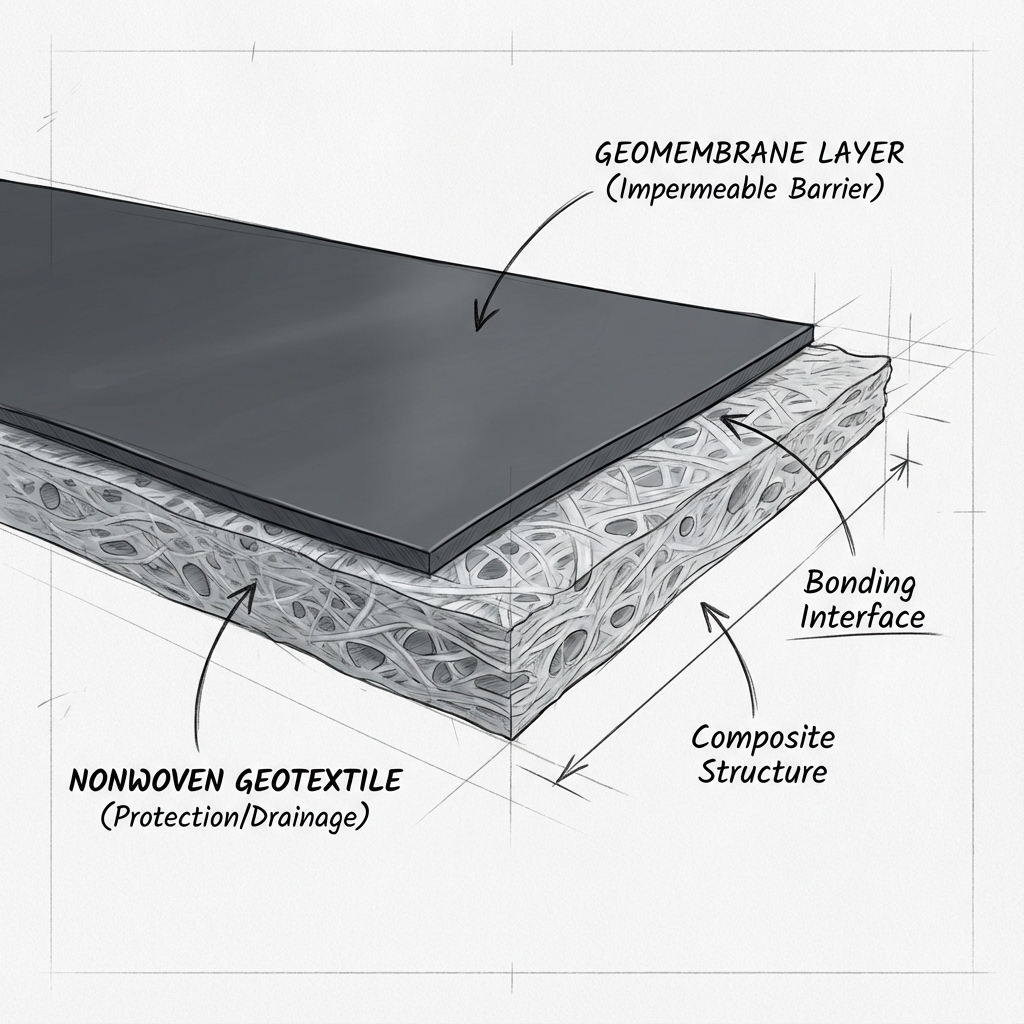
A geotextile composite geomembrane combines an impermeable geomembrane layer (HDPE/LDPE/PVC) with a bonded nonwoven geotextile (PET or PP). It’s often selected when you want a single product to deliver both barrier and protection.
Typical specification ranges from our product line include:
- Thickness: 0.5–2.5 mm
- Nonwoven weight: 100–800 g/m²
- Puncture resistance: ≥ 1.2 kN
- Tensile strength: ≥ 15 kN/m
- Elongation at break: ≥ 300%
Choose a composite when the subgrade is stony, slope stability is critical, or there’s a realistic chance of traffic-related abrasion. In many farm projects, a composite is a practical alternative to “standard liner + separate cushion,” while still meeting seepage control goals.
6) Water-savings payback: a simple, usable estimate
A correctly installed HDPE geomembrane pond liner reduces seepage losses to near-zero for practical farm planning. Here’s a simplified model you can adapt.
Inputs
- Pond area A (m²)
- Unlined seepage rate s (m/day) (often expressed as mm/day)
- Number of water-filled days per year D
- Water value (pumping + opportunity cost) C ($/m³)
Annual seepage volume (unlined):V = A × s × D
Example
- A = 5,000 m²
- s = 6 mm/day = 0.006 m/day
- D = 200 days
- C = $0.40/m³
V = 5,000 × 0.006 × 200 = 6,000 m³/year
Annual cost of seepage = 6,000 × 0.40 = $2,400/year
If the installed system (liner + geotextile + welding + QA/QC) is roughly $12,000, the simple payback is about 5 years—often faster when water is scarce, pumping is expensive, or stable water level improves aquaculture performance.
7) What to send us for a fast, accurate liner proposal
To recommend the right HDPE geomembrane pond liner (or LDPE pond liner) package, we typically ask for:
- Pond/reservoir area and average depth
- Subgrade description (clay, sand, gravel, rock; any sharp aggregates)
- Exposed or covered liner
- Target design life and local climate (UV intensity, temperature swings)
- Slope geometry and any traffic/maintenance needs
- Inlets/outlets/aeration devices (penetrations)
With those details, we can propose thickness, geotextile weight, seam layout (prefabricated vs field welding), and a practical QA/QC plan.
Explore products
Get a quote / technical support
8) FAQs
Which is usually better for outdoor aquaculture ponds?
For long-life, exposed ponds, an HDPE geomembrane pond liner is widely chosen for UV and chemical resistance. An LDPE pond liner is often selected when higher flexibility is essential.
Do I always need geotextile underlayment?
For most earthen ponds, yes. A nonwoven cushion is a low-cost way to protect an HDPE geomembrane pond liner from puncture and abrasion.
How do you confirm seam quality?
Standard practice includes air-channel pressure testing (fusion seams), vacuum box testing (extrusion/details), plus periodic destructive peel/shear tests with full documentation.
What thickness should I choose?
Many aquaculture projects use 0.75–1.5 mm HDPE geomembrane pond liner depending on subgrade and operations. Very large reservoirs or rough bases may justify thicker material or a composite.
References
Scheirs, J. (2009). A Guide to Polymeric Geomembranes: A Practical Approach. Wiley.
Islam, M. Z., Gross, B., & Rowe, R. K. (2011). Degradation of exposed LLDPE and HDPE geomembranes: A review. Geo-Frontiers Congress Proceedings. https://doi.org/10.1061/41165(397)211
Ng, H. B., & Qi, C. (2012). HDPE geomembrane applications in high altitude region. Conference paper via Semantic Scholar. https://www.semanticscholar.org/…
ASTM International. (2023). Standard test methods for geomembranes and welded seams (ASTM standards collection). West Conshohocken, PA.
Koerner, R. M. (2012). Designing with Geosynthetics (6th ed.). Xlibris.
Rowe, R. K. (2020). Long-term performance of polymeric geomembranes in containment applications. Geotextiles and Geomembranes, 48(3), 253–268.


