Geocell Slope Stabilization That Holds Up in Real Weather
On steep, erodible, or frequently saturated slopes, “simple” protection methods often fail in predictable ways: bare soil rills under heavy rain, riprap creeps and undermines at the toe, and concrete facings crack once water finds a path behind them. A geocell woven geotextile composite system addresses those failure points with a coordinated layer build-up—confinement at the surface, reinforcement in-plane, and controlled drainage. The result is geocell slope stabilization that is durable, easier to maintain, and more compatible with vegetation on road and railway embankments as well as riverbank protection.

How the Geocell–Geotextile Composite Works
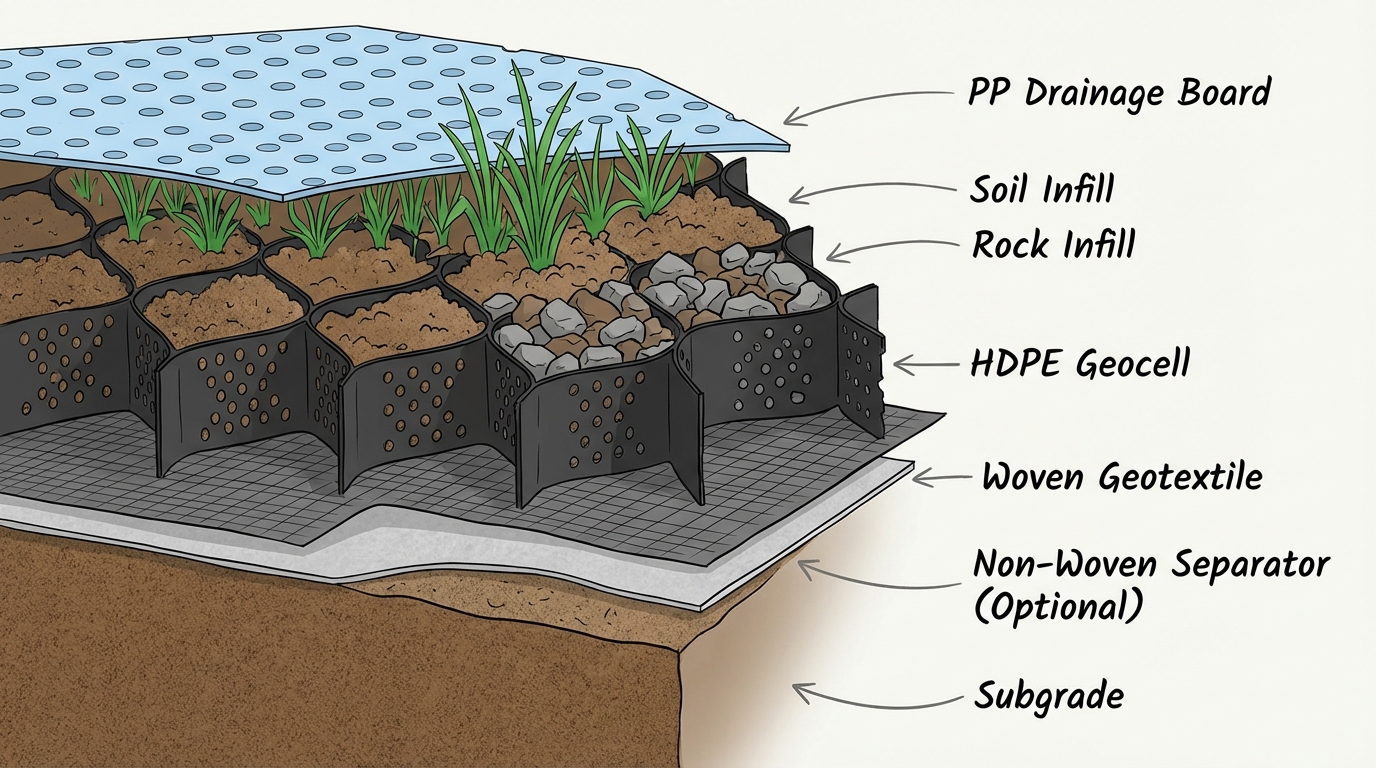
A well-designed geocell slope stabilization system is not a single product—it’s a mechanical partnership between layers. Each component does a specific job, and performance improves when they are selected as a set.
Core Layers in a Geocell Woven Geotextile Composite
HDPE Geocell (Surface Confinement)
A 3D honeycomb made from welded HDPE strips. Once expanded and filled, the cells confine soil or aggregate in three dimensions, which increases stiffness and shear resistance while reducing surface erosion. Typical cell heights for geocell slope stabilization range from 50–150 mm depending on slope angle, runoff energy, and whether the infill is soil or rock.
Product page: HDPE Geocell
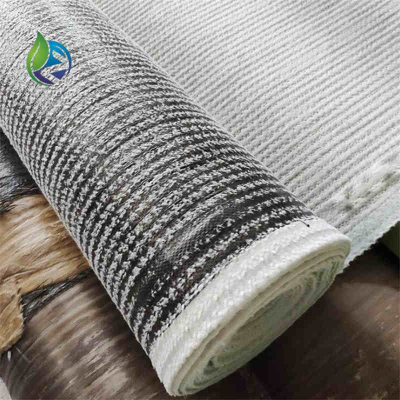
Woven Geotextile (In-Plane Tensile Reinforcement + Filtration)
A woven polypropylene or polyester fabric that provides high tensile strength along the slope plane and supports filtration/permeability so water can pass without dragging fine particles. In practice, woven geotextile helps geocell slope stabilization by reducing deformation and limiting soil loss behind the face.
Product page: Woven Geotextile
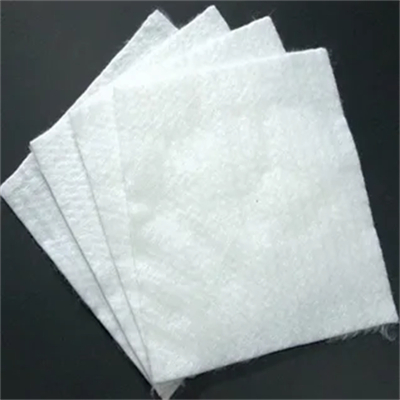
Non-Woven Separator (Optional, but Often Critical)
On silty, fine sand, or otherwise erodible subgrades, a non-woven separator prevents fine migration into the geocell infill and helps maintain drainage and long-term integrity. This layer is a common “small detail” that prevents big repair work later.
PP Drainage Board with Root Resistance (Water Management + Membrane Protection)
Where slopes connect to waterproofed structures, podium decks, planters, or retaining elements, drainage must be deliberate. A PP drainage board root resistance layer provides rapid discharge pathways, helps prevent water pressure buildup, and protects waterproof membranes from root penetration.
Product page: Drainage Sheets & PP Drainage Board
Where Geocell Slope Stabilization Performs Best: Three Common Use Cases
1) Cut-and-Fill Road and Railway Slopes
What typically goes wrong: Rainfall-driven rills, shallow slips, and progressive surface loss that triggers recurring maintenance.
Why the composite works: For geocell slope stabilization, the geocell locks the surface layer in place, while the woven geotextile provides reinforcement and controlled filtration beneath. If the subgrade is fine-grained, the separator prevents fines from pumping into the infill.
Typical build-up (field-proven):
- Grade and compact the slope
- (Optional) non-woven separator on erodible subgrade
- Woven geotextile over the slope plane
- HDPE geocell (often 75–100 mm for moderate slopes)
- Vegetated soil infill in low-energy zones; coarser infill at toe/runoff concentration zones
This combination supports geocell slope stabilization that remains stable through repeated wetting–drying cycles and improves the success rate of vegetated facings.

2) Riverbanks and Road Embankments
What typically goes wrong: Toe undermining, washout behind rigid facings, and loss of fine material under fluctuating water levels.
Why the composite works: In geocell slope stabilization for embankments, rock-filled cells provide armor where velocities and wave action are higher, and the woven geotextile reduces the risk of piping by retaining fines while allowing drainage.
Practical configuration notes:
- Use 100–150 mm geocell where hydraulic energy is higher
- Use rock/crushed aggregate infill in wave-impact or channel zones
- Use topsoil infill + seeding in upper zones where vegetation is feasible
- Add drainage sheets / PP drainage board in berms or behind interfaces where trapped water would increase uplift or soften the slope
This is a reliable approach to geocell slope stabilization when conditions vary seasonally and maintenance access is limited.

3) Vegetated Retaining and Landscape-Facing Slopes
What typically goes wrong: Steep “green” slopes look good at opening day, but lose soil during storms or deform when water is not managed.
Why the composite works: A geocell woven geotextile composite supports vegetation while adding confinement and reinforcement. Roots can interlock with the confined soil matrix, while water is guided through drainage layers instead of building pressure behind the face—an important factor in long-term geocell slope stabilization.
Layer-by-Layer: What Each Component Contributes
| Layer | Role in geocell slope stabilization | Why it matters on site |
|---|---|---|
| Compacted subgrade | Global support | Reduces settlement and slip potential |
| (Optional) non-woven separator | Separation + filtration | Prevents fines migration and clogging |
| Woven geotextile | Tensile reinforcement + filtration | Improves in-plane stability and drainage behavior |
| HDPE geocell | 3D confinement | Reduces erosion and lateral movement |
| Infill (soil/rock) | Mass + erosion armor or growth medium | Matches hydraulic energy and vegetation goals |
| Drainage sheets / PP drainage board | Drainage + root resistance | Protects membranes, prevents water pressure buildup |
Quick Selection Guide for Geocell Slope Stabilization
Use site conditions to choose the “right-sized” system—strong enough to last, but not overbuilt.
Cell Height
- 50–75 mm: Gentle slopes, low runoff energy, mostly erosion control.
- 75–100 mm: Common for road slopes and routine geocell slope stabilization.
- 100–150+ mm: Steeper slopes or higher hydraulic energy; rock infill zones.
Woven Geotextile
- Choose tensile strength based on slope geometry and stability needs.
- Confirm permeability/filtration suitability for the soil (avoid clogging and internal erosion).
Infill Choice
- Rock/aggregate: Channels, wave zones, concentrated flow paths.
- Vegetated soil: Low to moderate energy zones where green restoration is required.
Drainage and Root Resistance
- Add PP drainage board root resistance where waterproofing is present or planting/root intrusion is a concern.
Installation and QA Checklist
Even a strong design can underperform if details are missed. For geocell slope stabilization, quality is mostly about continuity: continuous reinforcement, continuous anchorage, continuous drainage.
- Prepare the slope: Grade to profile, compact, remove sharp objects.
- Lay separator (if used): Overlap sheets and secure temporarily.
- Install woven geotextile: Maintain overlaps; anchor at crest and toe.
- Expand geocell panels: Connect adjacent panels; fix at the crest first.
- Infill from bottom upward: Place in lifts; compact to avoid future bulging.
- Install drainage layers: Connect drainage board to outlets; keep paths unobstructed.
- Finish the facing: Seed/plant promptly for vegetated infill; ensure full coverage for rock infill.
- Detail toe and crest: Toe trenches, berms, and anchoring prevent progressive edge failure.
Common avoidable issues: Insufficient anchoring, gaps in overlaps, partial infill, and blocked outlets—each can compromise geocell slope stabilization faster than expected.
Durability, Inspection, and Typical Failure Modes
HDPE geocell and woven geotextile are widely used because they resist common site threats such as chemical exposure in typical soils, microbial degradation, and UV exposure within rated limits. Drainage layers add protection where water pressure or roots would otherwise shorten service life.
For ongoing geocell slope stabilization, inspect after major rain events and periodically thereafter. Watch for:
- Toe washout or erosion at drainage outlets
- Bulging cells (often linked to poor compaction or water concentration)
- Exposed geotextile due to localized loss of infill
- Anchorage pull-out near crest transitions
Most early-stage issues can be repaired locally by re-anchoring, replacing infill, and patching compatible geosynthetics.
FAQs
Q: When should a separator be placed under a geocell system?
A: Use it when the subgrade is silty, fine sand, or otherwise erodible. It improves geocell slope stabilization by preventing fines migration into the infill.
Q: Rock vs. vegetated soil infill—what’s the rule of thumb?
A: Match the energy level. Rock for high velocity/wave impact; soil + seed where flows are lower and ecological restoration is part of the goal.
Q: Can woven geotextile be left exposed?
A: Short exposure during installation is typically acceptable. For long-term exposure, follow the product UV rating and project specifications.
Q: Who decides anchorage spacing and geocell height?
A: Anchorage and cell height should be based on slope geometry, soil parameters, and hydraulic loads. For project-specific geocell slope stabilization selection, share site conditions and drawings so the configuration matches real constraints.
Next Steps: Product Pages and Technical Support
If you’re comparing options for geocell slope stabilization—from road slopes to embankment protection—start by aligning confinement, reinforcement, and drainage in one coordinated system.
- Explore products: Geocell, Woven Geotextile, Drainage Sheets & PP Drainage Board
- Request technical support, drawings, or a quotation: Contact us or sale01@zygeosynthetics.com
References
Song, G., He, S., Song, X., Duan, Z., Zhang, Y., Kong, D., & Huang, M. (2021). The use of geocell as soil stabilization and soil erosion countermeasures. Geomatics, Natural Hazards and Risk. https://doi.org/10.1080/19475705.2021.1954555
Song, X., Huang, M., He, S., Song, G., Shen, R., Huang, P., & Zhang, G. (2021). Erosion control treatment using geocell and wheat straw for slope protection. Advances in Civil Engineering. https://doi.org/10.1155/2021/5553221
Dorairaj, D., & Osman, N. (2021). Present practices and emerging opportunities in bioengineering for slope stabilization in Malaysia: An overview. PeerJ. https://doi.org/10.7717/peerj.10477
Richardson, G. N. (2004). Geocells, a 25-year perspective: Part 2—Channel erosion control and retaining walls. https://www.semanticscholar.org/search?q=GEOCELLS%2C%20A%2025-YEAR%20PERSPECTIVE.%20PART%202%3A%20CHANNEL%20EROSION%20CONTROL%20AND%20RETAINING%20WALLS&sort=relevance
Sanyal, T., Choudhury, P. K., & Goswami, D. N. (n.d.). Stabilization of embankment slopes with jute geotextiles—A case study in NH-2 Allahabad by-pass. https://jute.com/documents/10437/0/Jute+%28204-274%29.pdf/95828fb3-fb23-47e7-9020-bcd7d33357ef
BaseLok. (n.d.). GeoCell technical overview. https://baselok.com/geocell/
GeoFantex. (n.d.). Geocell erosion control case studies. https://geofantex.com/geocell-erosion-control-case-study.html