From Drawings to a Vendor-Ready Geosynthetics Procurement Checklist (Jinan Export Ordering)
Learn a practical 5-step method to convert engineering drawings to a bill of quantities and a vendor-ready geosynthetics procurement checklist—covering geotextile roll counts, geogrid takeoff, geomembrane ordering, waste allowances, and export-ready BOM fields for fast Jinan shipments.

When a new civil project package lands on your desk, geosynthetics often end up on the critical path: you must convert engineering drawings to a bill of quantities, complete a geosynthetics procurement checklist, and place an export order from Jinan that arrives without on-site shortages.
Below is the exact 5-step workflow our overseas buyers use—built for real procurement constraints (roll sizes, overlaps, MOQ, lead time, and inspection). If you follow it, you’ll end up with a clean geosynthetics procurement checklist and a vendor-ready BOM that our Jinan team can quote quickly.
Step 1 — Read drawings by function, then map to product families
Most drawings don’t say “buy Product X.” They describe what the layer must do. Start your takeoff by listing each geosynthetic layer by function + location, then map it to the right product category we manufacture in Jinan.
| Drawing intent (function) | What to list in your BoQ line | Typical ZY product category |
|---|---|---|
| Separation / filtration | Layer name + area (m²) | Geotextile (filament or short fiber nonwoven) |
| Drainage behind walls / basements / green roofs | Area (m²) or length (m) | Drainage sheets / dimple board / drainage board systems |
| Reinforcement in subgrade / slope | Area (m²) and direction | Geogrid (biaxial/uniaxial; custom tensile & aperture available) |
| Waterproofing / containment | Area (m²) + thickness | HDPE geomembrane (typical roll width 5–8 m) |
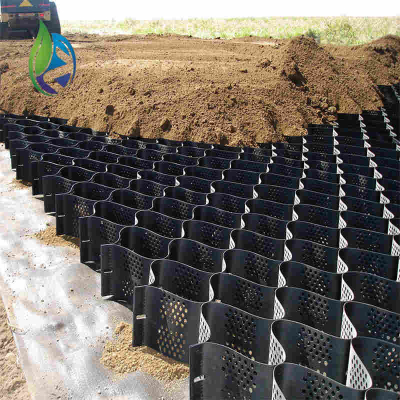
| Surface stabilization (parking, access roads) | Area (m²) + panel count | Grass paver (MOQ commonly 300 m²) |
Practical rule: In your draft BoQ, create one line per function + location (e.g., “Separation—Road Section A1,” “Drainage—Retaining Wall W3”). This structure makes the later geosynthetics procurement checklist fast and error-resistant.

Step 2 — Measure geometry and convert to purchase units (m², m, rolls, panels)
Your goal is not only “area on paper.” Your goal is purchase units: m², linear meters, roll counts, panels, or pallets.
2.1 Net takeoff (the clean drawing quantity)
- Flat areas (roads, working platforms): Area = length × width
- Sloped areas (pond slopes, landfill batters): use true surface length when shown; otherwise apply a slope factor.
A simple slope approximation that works well for early procurement:
Slope area ≈ plan area × √(1 + (V/H)²)
Record the result as Net Quantity in your BoQ. This is the number you’ll later uplift for laps and waste inside your geosynthetics procurement checklist.
2.2 Use usable width, not nominal width
For roll goods (geotextile, drainage sheet, geomembrane), drawings often imply continuous coverage. Procurement requires reality:
- Overlaps consume width.
- Edge trimming consumes width.
So in geotextile takeoff and roll count calculation, always base calculations on usable width (nominal width minus expected overlap/trim). This is one of the fastest ways to prevent “we are short 2 rolls” on site.
Step 3 — Build overlaps and waste into the BoQ (before ordering)
Shortages usually come from underestimating laps—especially on slopes, curved alignments, and detail-heavy zones.
Typical project guidance our buyers use:
- Geotextile overlap: 150–300 mm depending on subgrade condition and construction control
- HDPE dimple drain board overlap: typically 100–150 mm
- Grass paver waste: often 3–8% depending on cuts and edge geometry
- General waste allowance:
Make it auditable: Put lap/waste assumptions directly into the geosynthetics procurement checklist (as a waste % column), not hidden in personal notes.

Step 4 — Do the roll math (geotextile + geomembrane) and keep it supplier-realistic
This is where most procurement teams win or lose time. A good geosynthetic BOM template for procurement uses one consistent roll formula.
4.1 Practical roll-count formula
Use this for geotextile takeoff and roll count calculation and for geomembrane roll estimates:
| Calculation | What it does |
|---|---|
| Order Rolls = ceil( Net Area × (1 + waste%) ÷ (roll width × roll length) ) | Converts m² to roll count using real roll size |
Example:
- Net area = 1,000 m²
- Waste = 10%
- Roll size = 4 m × 100 m = 400 m²
- Rolls = ceil(1,000 × 1.10 ÷ 400) = 3 rolls
4.2 Engineer’s corner: geomembrane slopes + seams (quick checks)
For containment projects, you’ll often do geomembrane procurement from drawings before panel layouts are finalized.
- Apply a slope factor to plan area (as above).
- Add a conservative seam/detailing allowance (commonly 5–10% in early-stage estimates).
Why it matters: seam length affects welding time, QC sampling, and contingency planning—even if you only order rolls at this stage.
Step 5 — Turn the BoQ into a vendor-ready geosynthetics procurement checklist
Once your quantities are stable, the goal is speed: create one document that our Jinan export team can quote without back-and-forth.
5.1 Fields that make quotes fast (and prevent surprises)
Use the following BOM structure (it also works as a geosynthetics procurement checklist for internal approval):
- Item #
- Drawing reference (plan/section/detail)
- Function + location (separation, drainage, reinforcement, containment)
- Product (geotextile/geogrid/geomembrane/drainage sheet/grass paver)
- Key spec (e.g., geotextile mass, geogrid tensile, geomembrane thickness)
- Unit (m², m, roll, panel, pallet)
- Net quantity
- Waste % (laps/cuts/contingency)
- Order quantity
- Assumed roll/panel size (width × length)
- Packaging (roll wrap, palletizing, labeling)
- Documents needed (factory test report; other reports as required)
- Delivery window + Incoterm (FOB/CIF/CNF)
- Remarks (OEM label, batch coding, inspection request)
5.2 What to expect from our Jinan export supply pattern
To keep your Jinan geosynthetic supplier ordering predictable, these are common planning anchors:
- Lead time: many standard items ship in 10–20 working days after confirmation (depends on item and schedule).
- Geomembrane roll width: commonly 5–8 m.
- Grass paver MOQ: commonly 300 m².
- Geogrid customization: tensile strength and aperture size can be adjusted; standard and custom roll sizes are available.
Procurement tip: Where possible, round to full rolls or full pallets. It stabilizes packing lists and reduces partial-roll handling risk.
Quality control and risk control (what to put in the PO)
A strong geosynthetics procurement checklist is not only quantities—it also locks quality expectations into the contract.
Consider adding:
- Geogrid verification: tensile, junction strength, dimensional checks (typical ASTM/ISO-aligned testing)
- Geotextile verification: mass per unit area, tensile, permeability/flow tests
- Geomembrane verification: thickness, tensile/elongation; seam integrity checks and non-destructive seam testing where specified
- Durability expectations:
- Chemical resistance: PP and HDPE provide strong resistance to common soil chemicals and manure-related exposure
- Pre-shipment verification: packing list + photos; optional third-party inspection for critical projects
Best practice: approve a lab-tested sample before mass production on high-risk lines (containment liners, special-strength geogrids).
Copy-ready inquiry template (send with your checklist)
Paste this into email or WhatsApp to speed quoting:
Project: [Name / Location]
Delivery: [YYYY-MM-DD]   Incoterm: [FOB/CIF/CNF]   Destination port: [Port]

Item 1: Nonwoven geotextile (separation/filtration)
Spec: [e.g., 300 g/m²], usable width: [m], roll length: [m]
Net qty: [m²]   Waste: [10–15%]   Order qty: [m²]   Estimated rolls: [#]
Documents: Factory test report (mass/tensile/permeability)
Packaging: [palletized / non-palletized]
Item 2: Biaxial geogrid (reinforcement)
Spec: [tensile / aperture], roll size: [width × length]
Net qty: [m²]   Waste: [%]   Order qty: [m²]
Documents: tensile + junction strength + dimensional test report
Please confirm: available sizes, MOQ, lead time, packing, and quotation.
Contact: [Name / Company]
Next steps
If you want to shorten procurement time, send us your drawings (PDF/CAD export), target delivery window, and the first draft of your geosynthetics procurement checklist. Our technical team will help you:
- verify quantities,
- validate geotextile takeoff and roll count calculation,
- check geogrid quantity estimation from drawings,
- and confirm roll sizes that match Jinan production and export packing.
Request a quotation and technical documents: sale01@zygeosynthetics.comWhatsApp message
References
- International Organization for Standardization. (2016). ISO/TR 18228: Geosynthetics—Design using geosynthetics. https://www.iso.org/standard/65545.html
- International Geosynthetics Society. (2018). Guide to the Specification of Geosynthetics. https://library.geosyntheticssociety.org/society-documents/guide-to-the-specification-of-geosynthetics-2018/
- Fabricated Geomembrane Institute & International Association of Geomembrane Installers. (n.d.). Geomembrane installation guidelines. https://www.thefgi.org/specsguides/iagi-guidelines
- Spain, B. (1998). Taking Off Quantities: Civil Engineering. CRC Press. https://doi.org/10.1201/9781482271607
- 协会秘书处. (2024). 中国土工合成材料工程协会简报. 中国土工合成材料工程协会. http://www.chinatag.org.cn/uploads/soft/240226/1-240226161558.pdf
- Christopher, B., & Holtz, R. (1985). Geotextile Engineering Manual. Federal Highway Administration.
- Koerner, R. M. (1986). Designing with Geosynthetics. Prentice Hall.