HDPE Landfill Liner Thickness: 1.5 vs 2.0 vs 2.5 mm
Selecting the correct HDPE geomembrane thickness is arguably the single biggest driver of long-term landfill liner performance. It directly influences puncture resistance, seam welding reliability, slope stability (especially on steep sidewalls), and installation speed. Most importantly, it dictates how confidently your containment system can meet local environmental regulations over its intended service life. For most municipal facilities we supply, the practical decision usually comes down to a choice between 60 mil (≈ 1.5 mm) and 2.0 mm. We typically reserve 2.5 mm or thicker options for higher-risk conditions, harsher subgrades, or stricter jurisdictional regulations. This guide explains how we help engineers and contractors choose the right geomembrane thickness for landfill projects using a simple, field-focused approach.

At‑a‑Glance Thickness Starting Points
When we begin a consultation for a new containment cell, we use the table below as a starting point for HDPE geomembrane thickness selection. However, please remember that the final choice should always be confirmed against your specific design calculations, subgrade conditions, and local jurisdictional requirements.
| Application Type | Typical HDPE geomembrane thickness |
|---|---|
| Landscaping / temporary covers | 0.5–1.0 mm |
| Farm ponds / irrigation reservoirs | ≈ 1.0 mm |
| Municipal landfill bottom liner (baseline) | 1.5 mm (≈ 60 mil) |
| Municipal landfill with heavy traffic zones | 1.5–2.0 mm |
| Hazardous waste, mining, heap leach pads | 2.0–3.0 mm |
In day-to-day landfill engineering, the geomembrane thickness for landfill systems most commonly falls in the 1.5–2.0 mm range. This balance offers the best combination of cost-efficiency and mechanical robustness.
Regulatory Baselines and Real Design Drivers
Many jurisdictions globally use 60 mil HDPE as a practical baseline for municipal landfill liners. This is because 1.5mm material supports consistent seam welding and provides a defensible level of mechanical robustness under waste loading.
- U.S. & International Practice: Designs for composite lining systems commonly reference 60 mil (≈ 1.5 mm) HDPE for flexible membrane liners in municipal solid waste applications, aligning with EPA-related guidance and industry summaries.
- Stricter Standards: Some regions require thicker liners for certain facility classes. For example, German regulations are widely cited for specifying 2.5 mm HDPE in specific landfill composite liner configurations to ensure maximum longevity.
In our experience at Zhuyuan New Materials Co., Ltd., the final HDPE geomembrane thickness is usually driven by a few “make-or-break” field realities rather than just the textbook minimums:
- Regulatory minimums and project approval conditions.
- Subgrade quality (presence of sharp stones, hard inclusions, or poor grading tolerance).
- Construction traffic (haul roads, compactors, dozers, sumps, and transitions).
- Waste and leachate aggressiveness (municipal vs. industrial/hazardous).
- Service life expectations and acceptable risk.
We supply HDPE geomembranes in a full 0.5–3.0 mm thickness range, enabling a zone-based design approach. This allows you to use a baseline thickness for the cell floor while upgrading to thicker material for slopes, sumps, and high-traffic areas without forcing a one-size-fits-all solution.
Thickness Trade‑Offs: Puncture Resistance vs. Handling
Within the core landfill range, stepping up HDPE geomembrane thickness generally improves damage tolerance—especially puncture resistance—and can reduce the probability of repairs during installation. However, it's important to note that thicker liners are heavier, stiff, and more demanding to weld consistently.
What Thickness Changes in Performance
Across our standard product range (0.5–3.0 mm), typical technical targets include:
- Tensile strength at yield: 16–28 MPa
- Elongation at break: 600%–800%
- Puncture resistance: 600–1200 N (thicker sheets trend significantly higher)
- Carbon black content: 2.0%–3.0% for UV durability
- Buried design service life: 20–30+ years under standard conditions
Here is a simplified, buyer-friendly view of geomembrane thickness for landfill selection:
| Nominal Thickness | Typical Landfill Use | Relative Damage Risk | Notes for Installers |
|---|---|---|---|
| 1.5 mm (60 mil) | Baseline HDPE landfill liner | Moderate | Best balance for most MSW cells when subgrade is well prepared. |
| 2.0 mm | High-load zones, sumps, transitions | Low–moderate | Heavier rolls; welding parameters (heat/speed) must be controlled carefully. |
| 2.5 mm | Severe subgrades, higher-risk facilities | Low | Stiffer; performs best on well-finished bases and requires expert seam work. |
Cost and Construction Implications
When deciding on HDPE geomembrane thickness, it helps to budget beyond the raw material price per square meter. Thicker liners increase roll weight, which may require more capable deployment equipment on site. Stiffer sheets can also be harder to conform to irregular grades or tight details, requiring more labor time.
Furthermore, welding thicker HDPE demands disciplined control of temperature, speed, and pressure—especially for long production seams. For many municipal landfills, a common value-driven approach we see is using 1.5 mm HDPE over a prepared subgrade, with geotextile cushioning and 2.0 mm upgrades in higher-risk zones.
Protection and Installation: A Practical Checklist
Even the thickest HDPE geomembrane thickness can be compromised by poor subgrade prep, rushed welding, or missed quality control. Conversely, smart protection strategies can allow a compliant, standard thickness to perform reliably for decades.
1. Subgrade and Cushioning
The surface preparation is critical. The soil base must be graded and compacted to a smooth surface, with all sharp rocks, debris, and protrusions removed. Where stone content or construction traffic increases the risk of damage from below, we strongly recommend adding a nonwoven geotextile cushion beneath the HDPE landfill liner.
This geotextile layer acts as a protective buffer, absorbing point loads and preventing sharp objects from puncturing the membrane under the immense weight of the waste pile.

2. Welding and Seam Quality
Proper installation is just as vital as the material itself. We advise the following best practices:
- Plan Panel Layout: Minimize field seams by planning the layout carefully. Our roll widths are typically 5.8 m to 8 m, which helps reduce the number of welding passes required.
- Welding Methods: Use hot‑wedge welding for long, straight production seams. This method creates a double track with an air channel for testing. Use extrusion welding for patches, details, and repairs where the wedge welder cannot reach.
- Field Verification: Quality control should include non-destructive dual-track air pressure testing and vacuum box testing, alongside destructive peel and shear testing on sample coupons.
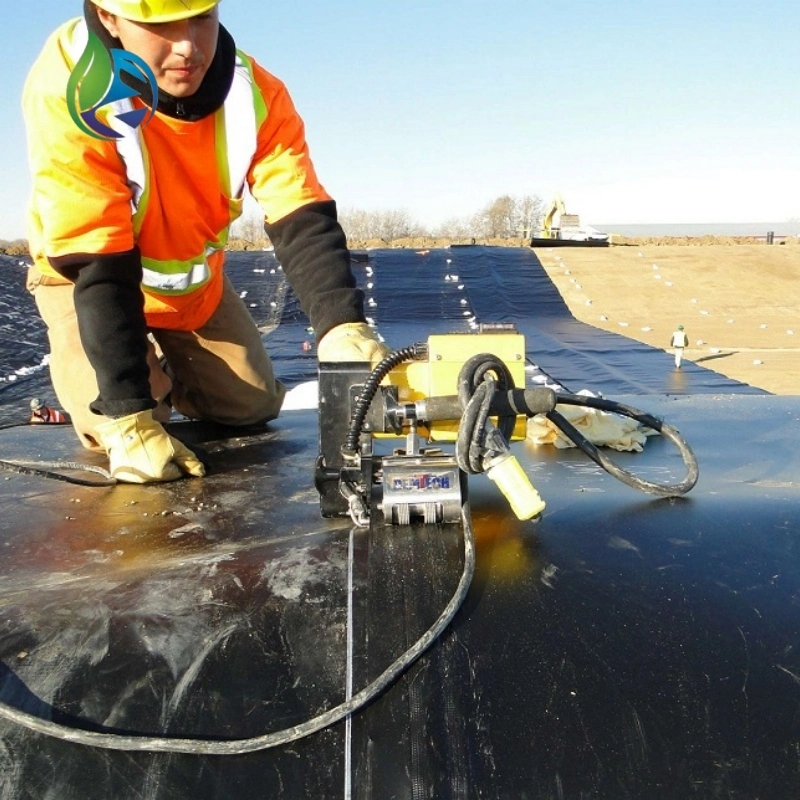
Operational Note: To reduce construction-phase aging (UV degradation and thermal expansion/contraction), limit the exposure time before covering the liner. Depending on the climate and schedule, we often recommend covering the liner with protective soil or drainage layers within 2–4 weeks of installation.
Slopes, Interface Friction, and Textured HDPE
Smooth liners offer excellent impermeability, but slope stability is heavily influenced by the interface friction between the geomembrane and adjacent soils or geotextiles. If your landfill design includes steep side slopes, benches, or capping layers, the surface finish becomes a critical part of the safety calculation.
In these scenarios, simply increasing thickness isn't enough. You must specify textured HDPE where interface friction is critical. The engineered surface roughness improves shear resistance, preventing the soil cover from sliding off the liner. Always coordinate the liner type and HDPE geomembrane thickness with your slope stability checks, and use anchor trenches and berms as required by the design.
Step‑by‑Step Thickness Decision Flow (Field-Proven)
When supporting EPC teams and facility owners, we typically recommend the following sequence for choosing the right geomembrane thickness for landfill systems:
- Confirm the local minimum: This is often 1.5 mm / 60 mil HDPE, but it is not universal.
- Define the risk profile: Is this a standard MSW cell, or is it for industrial/hazardous waste or mining tailings?
- Map mechanical loads by zone: Identify haul routes, sumps, transitions, and pipe penetrations where stress is highest.
- Review subgrade reality: Assess stone size, compaction methods, and the contractor's tolerance for rework.
- Check slope stability needs: Determine if smooth or textured liner is needed, and verify anchoring requirements.
- Match thickness to construction capability: Ensure the installation crew has the resources for deployment and seam QC of the chosen thickness.
As a quick rule of thumb:
- Municipal MSW: 1.5–2.0 mm is the typical HDPE geomembrane thickness band.
- Higher-risk or high-load areas: 2.0–2.5 mm is often justified.
- Mining or aggressive chemical exposure: 2.0–3.0 mm is commonly specified.
FAQ: HDPE Geomembrane Thickness for Landfills
Is 60 mil (1.5 mm) always acceptable?
Often, 60 mil HDPE is treated as a practical minimum for MSW composite liners, but acceptance depends entirely on local rules and risk conditions. Heavy traffic zones and coarse subgrades commonly push the design toward 2.0 mm for added safety.
When should I choose textured HDPE?
You should use textured liners on side slopes, caps, and any zone where interface friction is part of the stability design. The texturing increases friction angles significantly compared to smooth sheet.
Can protection layers reduce puncture risk without changing thickness?
Yes. Subgrade refinement combined with a high-quality nonwoven geotextile cushion can significantly reduce puncture risk, allowing a standard compliant HDPE geomembrane thickness to perform effectively without needing to upgrade to a thicker, more expensive sheet.
What are typical supply terms?
At Zhuyuan New Materials, our standard lead time is typically 10–20 working days, and our MOQ is generally 300 m², though this is subject to specific specification requirements and shipping schedules.
Next Steps: Get the Right Thickness for Each Zone
Choosing HDPE geomembrane thickness is rarely a single-number decision. Most successful projects match thickness and surface finish to the actual zones that control risk—base, slopes, sumps, transitions, and traffic corridors—then protect the liner with disciplined subgrade work and verifiable seam quality.
If you want a fast thickness recommendation based on your cell layout and operating conditions, our team is ready to share datasheets, typical welding guidance, and sample material for evaluation.