Desert Roads That Don’t Rut: Geocell + 3D Geomat Best Practices
Desert roads built on loose aeolian sand fail in familiar ways: rapid rutting, edge breakdown at shoulders, wind-driven sand encroachment, and sudden storm runoff that scours unprotected slopes. A reliable approach to desert subgrade stabilization is to treat the roadbed and the side slopes as one system—using geocell road stabilization in the wheel path and 3D geomat desert slopes protection on embankments, supported by a subgrade separation geotextile and practical drainage layers.

Key Best Practices (Field-Friendly)
- Specify UV-stabilized HDPE for exposed or shallow-cover geocell road stabilization sections.
- Confirm design inputs early (grain size, CBR, MDD/Proctor, moisture sensitivity, axle loads) to avoid overbuilding.
- Install a subgrade separation geotextile over loose sand before placing the geocell layer.
- Use angular, well-graded crushed stone as infill; avoid rounded particles that can “roll” under load.
- Target ≥90–95% MDD for geocell infill compaction (project-specific acceptance).
- Keep 50–75 mm cover above the geocell before trafficking or paving.
- Protect side slopes with 3D geomat desert slopes reinforcement and add drainage to manage episodic runoff.
1) Site Investigation: Don’t Skip the Basics
Successful desert subgrade stabilization starts with fast, practical testing—not guesswork:
- Grain-size distribution: confirms uniform sand and identifies fines that may pump upward.
- CBR: defines how aggressive your geocell road stabilization design needs to be.
- Proctor/MDD: sets realistic compaction targets in typically dry desert conditions.
- Seasonal moisture + storm history: rare rains can temporarily weaken the subgrade.
- Traffic spectrum: access tracks vs. highway lanes vs. mine haul roads demand different cell heights.

Field studies on geocell-reinforced aeolian sand confirm what crews see in practice: confinement increases bearing performance and helps limit deformation, supporting more efficient pavement sections when designed correctly.
2) Product Matching: Roadbed vs. Slope (A Quick Comparison)
| Need | Best-fit layer | What it does | Typical pairing |
|---|---|---|---|
| Rutting control in loose sand | Geocell road stabilization | Confinement + load distribution in a cellular confinement system | Separation geotextile + crushed infill |
| Wind/rain erosion on embankments | 3D geomat desert slopes | Traps sand/soil, supports vegetation establishment | Topsoil/seed + anchoring |
| Flash-runoff management | Drainage products | Moves water safely; can also help moisture retention for vegetation | Drainage cell / water storage drainage board |
HDPE Geocell (Road Subgrade Reinforcement)
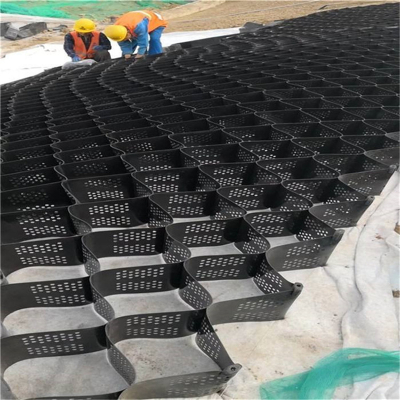
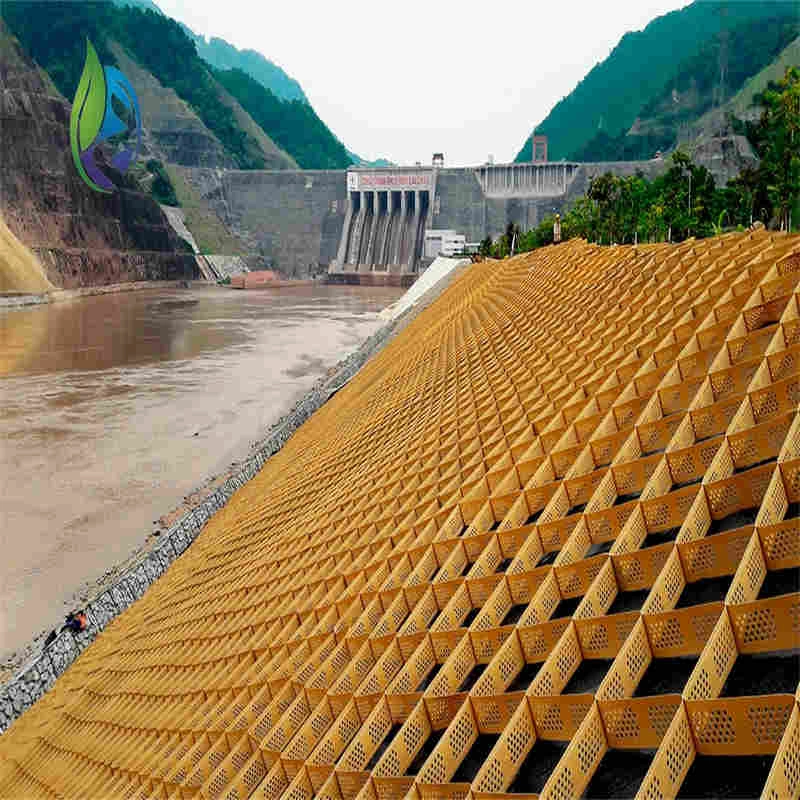
Our Geocell for Road Subgrade Reinforcement is manufactured through polymer compounding, sheet extrusion, strip cutting, CNC ultrasonic welding, inspection, and compact folding for transport. In desert subgrade stabilization, the honeycomb structure confines aggregate and redistributes wheel loads laterally—an effective method for geocell road stabilization on weak sands.
Typical selection ranges (final design by the engineer of record):
- 75–100 mm: light-duty access roads
- 150–200 mm: highways, heavy trucks, mine haul roads, very low CBR sand
Plastic 3D Geomat (Desert Slope Protection)
Our Plastic 3D Geomat (EM3/EM4/EM5) is designed for vegetation protection and erosion control.
- Thickness: 10–16 mm
- Standard width: 2 m (customizable)
- Tensile break strength: 0.8–3.2 kN/m
- Colors: black or green
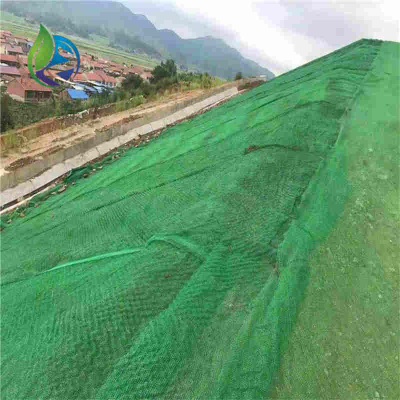
On embankments, 3D geomat desert slopes performance comes from its three-dimensional matrix: it holds topsoil and seed in place, reduces rill erosion, and helps stabilize the shoulder environment that affects the road edge.
3) Installation Sequence for Geocell Road Stabilization (Crew Checklist)
- Prepare the sand subgrade
- Place the subgrade separation geotextile
- Install the geocell panels
- Infill + geocell infill compaction
This workflow is simple, repeatable, and scalable—exactly what desert projects need to keep desert subgrade stabilization consistent across long alignments.
4) 3D Geomat Desert Slopes + Drainage for Storm Events
For slopes, install 3D geomat desert slopes protection from crest to toe with close ground contact:
- Anchor in a trench at the crest and toe, plus pins across the face.
- Backfill the matrix with topsoil or sand/soil mix, then seed/plant.
Because desert drainage is “quiet until it isn’t,” pair slope protection with drainage solutions where runoff concentrates. Depending on the project goal, a drainage layer can either move water away quickly or store limited moisture to support vegetation.

5) Typical Use Scenarios (What Buyers Ask For)
- Desert highway widening: Use geocell road stabilization over a subgrade separation geotextile to control rutting and support efficient base design; protect shoulders with 3D geomat desert slopes to reduce wind erosion.
- Mine haul road on loose sand: Select deeper geocell (often 150–200 mm) and prioritize durable infill plus strict geocell infill compaction to reduce grading frequency.
In both scenarios, treating the road and slopes together improves desert subgrade stabilization outcomes—performance and maintainability.
FAQ
How long does geocell road stabilization last under strong UV?
Use UV-stabilized HDPE for exposed or shallow-cover applications. Product test data can be provided for review.
Do I always need a subgrade separation geotextile?
On loose aeolian sand, yes—separation helps prevent sand migration into the base and preserves drainage.
Can 3D geomat desert slopes work without vegetation?
Yes. The matrix still traps sand and reduces surface erosion; vegetation improves long-term stability when feasible.
What are the most important acceptance checks?
Geocell weld integrity, geotextile overlap/anchorage, infill gradation, and documented geocell infill compaction results.
Request Datasheets, Layout Support, or Samples
Zhuyuan New Materials Co., Ltd. supplies an integrated system for desert subgrade stabilization, including HDPE geocell, Plastic 3D Geomat, Non Woven Geotextile Fabric, and drainage products.
- WhatsApp: +86 15615641112
- Email: sale01@zygeosynthetics.com
- Explore products: Geocell | 3D Geomat | Geotextile
References
- Liu, J., Pan, J., Gao, B., Liu, J., Hu, C., & Du, H. (2024). Field study on vibration characteristics of geocell-reinforced aeolian sand subgrades. Scientific Reports. https://doi.org/10.1038/s41598-024-69683-y
- Schary, Y. (2020). Guidelines for the Use and Design of Geocells in Road Reinforcement Applications. https://doi.org/10.1007/978-981-15-6095-8_14
- Jing, H.-J., & Jin, H.-W. (2006). Application of geocell to strengthen expressway subgrade in desert. Journal of Chang’an University. https://www.semanticscholar.org/search?q=Application%20of%20geocell%20to%20strengthen%20expressway%20subgrade%20in%20desert&sort=relevance
- Presto GeoSystems. (n.d.). Roadbase stabilization with 3D geocell. https://www.prestogeo.com/applications/roads-highways/roadbase-stabilization/
- ASTM International. (2017). ASTM D1883: Standard Test Method for CBR of Laboratory-Compacted Soils. https://www.astm.org/d1883
- ASTM International. (2021). ASTM D698: Laboratory Compaction Characteristics of Soil Using Standard Effort. https://www.astm.org/d0698